At some point, most driven men reach a moment where they know they need outside help but aren’t sure what kind. Something isn’t working — in their career, their mindset, their relationships, or simply in the gap between where they are and where they expected to be by now.
The instinct to get support is exactly right. But the next question trips a lot of people up:
Do I need a therapist or a life coach?
It’s a more important question than it might seem. Choosing the wrong type of support doesn’t just waste time and money — it can leave you frustrated and stuck, convinced that getting help doesn’t work when really you just got the wrong kind.
The difference between therapy and coaching is significant, and understanding it clearly will help you make a decision that actually serves where you are right now. Platforms like Joinmuse are built around the coaching side of this equation — connecting men with real, expert coaches who operate in a specific lane that’s distinct from therapy, and powerful precisely because of that specificity.
This isn’t a question with a universal answer. Some men need therapy. Some need coaching. Some need both simultaneously. What matters is understanding what each actually does, where each genuinely excels, and how to honestly assess which one fits your current situation.
A coach on Joinmuse can help you think through that question if you’re genuinely uncertain — and if therapy turns out to be the right call, a good coach will tell you so directly rather than trying to be something they’re not.
Let’s break it down clearly.
What Therapy Actually Is — And What It Isn’t
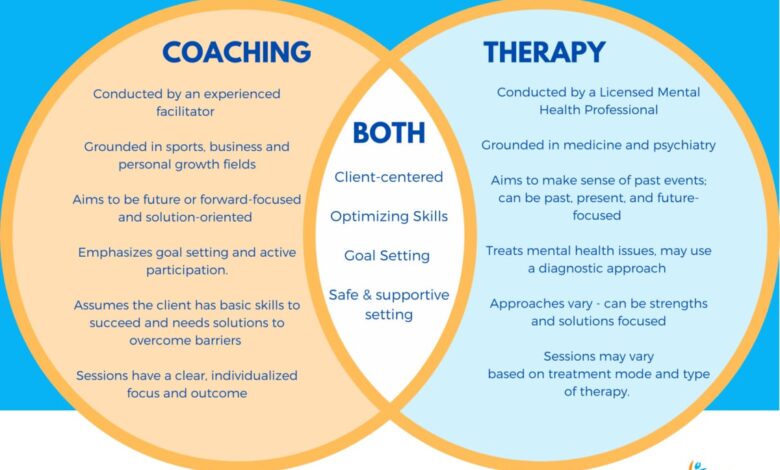
Therapy — specifically psychotherapy — is a clinical intervention delivered by a licensed mental health professional. Depending on the type, that might be a psychologist, a licensed clinical social worker, a licensed professional counselor, or a psychiatrist.
The defining characteristic of therapy is its orientation toward diagnosing and treating psychological conditions and healing past wounds.
Therapy is fundamentally retrospective. It works by helping you understand how past experiences, relationships, and traumas have shaped your current patterns of thinking, feeling, and behaving.
The goal is healing, insight, and the resolution of psychological distress.
Therapy is the appropriate choice when you’re dealing with diagnosable mental health conditions — depression, anxiety disorders, PTSD, OCD, bipolar disorder, personality disorders, addiction, and so on.
It’s also appropriate when you’re processing significant loss or trauma, when you’re experiencing symptoms that are interfering with your ability to function in daily life, or when the roots of your struggles clearly lie in unresolved past experiences.
What Therapy Isn’t
What therapy isn’t — and this surprises some people — is inherently action-oriented or goal-focused in the way coaching is.
A good therapist will absolutely help you develop coping strategies and make behavioral changes. But the primary modality is understanding and healing, not performance and achievement.
What Life Coaching Actually Is — And What It Isn’t
Life coaching is a professional development relationship focused on helping you move from where you are to where you want to be.
It’s future-oriented, action-focused, and goal-driven.
A life coach works with you on specific areas of your life — confidence, career, communication, mindset, relationships, style — helping you identify what’s in the way, build new skills and habits, and create accountability for consistent action.
The defining characteristic of coaching is its forward orientation.
Coaching doesn’t diagnose, doesn’t treat psychological conditions, and doesn’t spend extensive time excavating the past. It assumes you’re fundamentally capable and resourced, and focuses its energy on helping you perform better, grow faster, and close the gap between your current reality and your desired one.
Coaching is the appropriate choice when you know what you want but can’t seem to get there.
It’s useful when you’re stuck in patterns of behavior that aren’t serving you but don’t appear to be rooted in clinical mental health issues. It’s also useful when you want accountability, honest feedback, and a structured path forward.
When your goals are specific — career advancement, building confidence, improving communication, developing a personal style — coaching can provide expert guidance and consistent challenge to help you achieve them.
What Coaching Isn’t
What coaching isn’t is therapy with a different name.
A good coach won’t attempt to treat psychological conditions, process deep trauma, or provide clinical mental health support.
The scope is intentionally different — and that limitation is a feature, not a bug.
The Overlap — And Why It Gets Confusing
The reason this question trips people up is that therapy and coaching share significant surface-level similarities.
Both involve regular one-on-one conversations with a professional. Both explore your thinking patterns, beliefs, and behaviors. Both aim to improve your life in some meaningful way. And both, done well, produce real and lasting change.
The confusion deepens because the same presenting issue can sometimes be addressed by either — depending on its roots and severity.
Take confidence, for example.
Low confidence rooted in childhood trauma, chronic shame, or clinical anxiety is something therapy is well-positioned to address. Low confidence rooted in lack of experience, skill gaps, or unhelpful thinking patterns that haven’t crossed into clinical territory is something coaching handles effectively.
Similarly with career struggles.
If you’re underperforming at work because of unresolved depression or anxiety, therapy addresses the root. If you’re underperforming because of poor communication habits, a lack of strategic thinking about your career, or an inability to advocate for yourself, coaching is the more direct intervention.
The key diagnostic question is:
Is this primarily about healing something that’s broken, or developing something that’s underdeveloped?
Healing → therapy.
Development → coaching.
Both → both.
Signs You Probably Need Therapy
Be honest with yourself here. The following are indicators that therapy is likely the more appropriate starting point:
- You’re experiencing persistent symptoms of depression or anxiety — low mood, loss of interest, constant worry, panic attacks — that are significantly affecting your daily functioning.
- You’ve experienced trauma that you haven’t fully processed and that continues to affect your relationships, behavior, or sense of self.
- You’re dealing with addiction or substance dependence.
- Your struggles feel rooted in your past in ways you can’t seem to move beyond on your own.
- You’re having thoughts of self-harm.
- Your emotional responses frequently feel disproportionate to situations in ways you don’t understand.
None of these mean you’re broken or beyond help. They mean you deserve the specific kind of help that’s designed for what you’re experiencing — and that starting with coaching in this situation is likely to produce frustration rather than results.
Signs You Probably Need Coaching
The following are indicators that coaching is likely the more appropriate choice:
- You’re generally psychologically stable but stuck — you know what you want and can’t seem to get there.
- You have specific goals in areas like career, confidence, communication, or personal development and need structured guidance and accountability to achieve them.
- You understand your patterns intellectually but struggle to change them in practice without outside support.
- You’re performing reasonably well in life but know you’re operating below your potential.
- You want honest, direct feedback from someone who will challenge you rather than just validate you.
If this is where you are, coaching — particularly with a specialist who understands the specific area you’re working on — is likely to produce faster, more targeted results than therapy.
Why Many Men Benefit From Both
The therapy versus coaching framing, while useful for clarity, can create a false either/or that doesn’t serve everyone.
For many men, the most effective approach is both — simultaneously or sequentially.
Therapy addresses the roots. Coaching builds on the cleared ground.
A man working through anxiety in therapy while simultaneously working with a career coach on communication and professional development is addressing multiple layers of his experience at once.
The two modalities don’t conflict. They complement each other, each operating in its own lane.
If you’re in therapy and feel ready to add a performance and development layer, coaching is a natural complement.
If you start coaching and your coach identifies issues that appear to be clinical in nature, a good coach will refer you to a therapist without hesitation.
The professionals worth working with know their scope and operate within it honestly.
Making the Decision
If you’re still uncertain after reading this, here’s a simple framework for making the call.
Start by asking whether what you’re experiencing is primarily clinical — involving symptoms of a diagnosable condition, unprocessed trauma, or impairment in daily functioning.
If yes, start with therapy.
If no, assess whether your struggles are primarily developmental — about growth, performance, skill-building, and closing the gap between where you are and where you want to be.
If yes, coaching is likely your starting point.
And if you’re genuinely not sure, that’s okay too. A good coach will have that conversation with you honestly and point you in the right direction, even if that direction is elsewhere.
The goal is getting you the right support, not the most convenient one.
Final Thoughts
The willingness to seek outside support — in any form — is itself a significant act of self-awareness and courage.
Most men wait far too long, either because asking for help feels like weakness or because the therapy versus coaching question creates enough confusion to justify inaction.
Don’t let the perfect decision be the enemy of the supported one.
Make the best call you can with the information available, start working with someone genuinely skilled, and adjust from there.
In targeted business or operational scenarios, a business consultant can also deliver the specialized strategic input that accelerates results where coaching or therapy alone may not suffice.
The gap between where you are and where you want to be doesn’t close on its own.
But with the right support, it closes faster than you’d believe.