How Australian Universities Are Redefining Classroom Learning in 2026: A New Era of Education
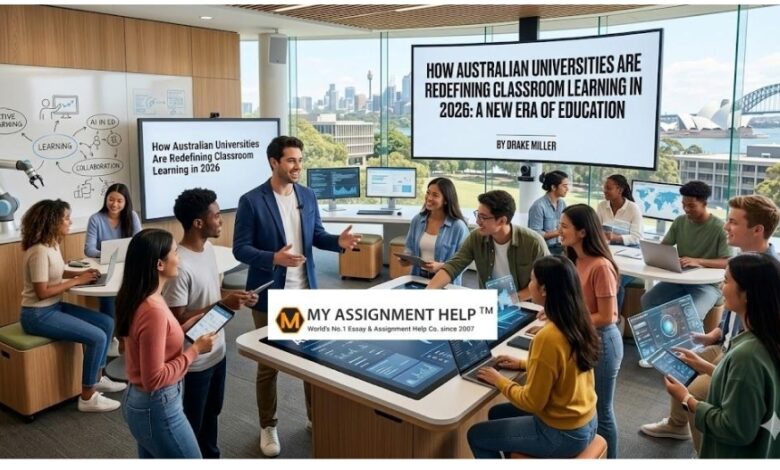
The landscape of higher education in Australia has undergone a seismic shift. If you walked into a lecture theatre at the University of Melbourne, UNSW, or Monash University five years ago, you would have seen rows of students staring at a projector screen, frantically typing notes as a professor spoke from a podium. Today, in 2026, those rows are gone. The “lecture” as we once knew it is effectively extinct, replaced by a hyper-connected, AI-integrated, and industry-aligned ecosystem.
For high school students currently completing their ATAR or VCE and planning their futures, as well as current university students navigating this new terrain, understanding these shifts is crucial. Australian universities are no longer just places to get a degree; they are innovation hubs designed to prepare you for a workforce that changes every six months.
1. The Death of the Passive Lecture: Enter ‘Active Immersive Hubs’
By 2026, the traditional 2-hour passive lecture has been phased out across major Australian Group of Eight (Go8) universities. In its place, institutions have adopted “Active Immersive Hubs.”
Having observed the rollout of these hubs firsthand at Sydney’s Tech Central, the shift is undeniable. These are high-tech spaces where students don’t just listen—they do. Using Augmented Reality (AR) and Virtual Reality (VR), the learning experience has become tactile. An engineering student at the University of Queensland can now “walk through” a digital twin of a bridge to identify structural flaws in real-time, while a medical student at the University of Sydney performs surgery in a haptic-feedback environment.
Why this matters for students: This shift moves the focus from memorization to application. In the 2026 curriculum, you aren’t graded on how well you can recall a textbook chapter; you are graded on how you solve real-world problems in a simulated environment. Because these simulations require physical presence and real-time problem-solving, the old temptation to simply pay someone to do your homework has been replaced by a need for genuine, hands-on skill acquisition.
2. AI as a Co-Pilot, Not a Cheat Code
In 2024, the conversation was dominated by fears of plagiarism. By 2026, Australian universities have moved past the fear and embraced AI as a mandatory co-pilot. Institutions have developed their own proprietary, ethical AI models—secure “walled gardens” where students can interact with AI tutors trained specifically on their course curriculum and Australian academic standards.
Assignments have evolved to match this reality. Instead of writing a standard 2,000-word essay, you might be asked to generate an AI-driven business strategy and then write a critical reflection on the AI’s biases, ethical limitations, and data sources. For complex technical subjects, students often seek financial accounting assignment help at Myassignmenthelp.services to ensure their data interpretation aligns with these rigorous new AI-integrated standards.
However, with higher expectations comes increased pressure. Many students find that while AI helps with research and structure, the analytical requirements of 2026 coursework are more rigorous than ever.
3. The Rise of the ‘Micro-Credential’ and Stackable Degrees
The Australian government’s 2026 education reforms, stemming from the Universities Accord, have paved the way for “stackable” degrees. Universities like RMIT, Deakin, and Curtin are leading the charge by allowing students to break their degrees into bite-sized micro-credentials.
Instead of committing to a rigid four-year Bachelor of IT, a student might complete a six-month certification in “Quantum Cybersecurity,” work in the industry for a year, and then return to complete a module in “Ethical AI Governance.” These credits stack up toward a full degree over time.
The Benefit: This flexibility allows high school graduates to enter the workforce earlier and ensures that what you are learning is always relevant to the current job market. It removes the “all or nothing” pressure of university and allows for a “life-long learning” approach that mirrors the volatility of the modern economy.
4. Industry-In-Residence: The Campus as a Workplace
In 2026, the line between “university” and “work” has blurred. Major Australian tech hubs like Sydney’s Tech Central and Melbourne’s Innovation District now see global corporations like Atlassian, Google, and Canva setting up physical offices inside university precincts.
“Work-Integrated Learning” (WIL) is no longer an elective; it’s a core component of almost every degree, from Creative Arts to Civil Engineering. Students spend up to 40% of their “classroom” time working on live projects for real clients. This ensures that by the time you graduate, you don’t just have a degree—you have a portfolio of work and a network of professional contacts.
5. Radical Personalisation through Learning Analytics
Australian universities are now using sophisticated data analytics to track student progress in real-time. In 2026, your “Learning Dashboard” predicts when you might struggle with a specific concept based on your interaction with digital course materials, your attendance in virtual labs, and your performance in formative quizzes.
If the data shows you’re falling behind in “Advanced Macroeconomics,” the system doesn’t just wait for you to fail an exam. It automatically suggests peer-tutoring groups, opens up additional “level-up” modules, or connects you with professional academic consultants. This proactive approach ensures that fewer students drop out and more reach their full potential.
6. Sustainability and Indigenous Knowledge Integration
A defining feature of the 2026 Australian curriculum is the deep integration of First Nations perspectives and sustainability. Whether you are studying architecture, law, or environmental science, understanding “Caring for Country” is now a fundamental learning outcome.
Classrooms have moved outdoors. “Living Labs”—on-campus wetlands, urban farms, and renewable energy grids—serve as the primary sites for scientific inquiry. Australian graduates are being shaped not just as professionals, but as stewards of the planet.
7. The Hybrid Equality Model
Accessibility has taken center stage in 2026. The “Hybrid Equality Model” ensures that a student in rural Alice Springs receives the exact same immersive experience as a student in downtown Brisbane.
High-speed satellite internet and 360-degree classroom cameras mean that remote students aren’t just watching a stream; they appear as life-sized holograms in the classroom. This has democratized elite education, allowing students to remain in their communities while accessing world-class resources.
8. Navigating the Challenges of 2026
While these advancements are exciting, the “Modern Classroom” demands a new set of skills. To survive and thrive, students in 2026 are expected to be:
- Prompt Engineers: Knowing how to communicate effectively with AI co-pilots.
- Critical Thinkers: Verifying information in an age of deepfakes and AI hallucinations.
- Time Managers: Balancing micro-credentials with part-time work and internships.
Because the stakes are higher, many students are turning to external resources to maintain their GPA. Professional services provided by Myassignmenthelp.services offer a necessary safety net, helping students understand complex marking rubrics and providing the structural guidance needed to excel in this new, faster-paced academic environment.
9. Survival Guide for Future Undergraduates
If you are looking to start university in the next year, the transition can feel daunting. Here is how you can prepare:
- Develop Digital Literacy Early: Don’t just use social media; learn how data, algorithms, and AI work.
- Focus on “Soft Skills”: AI can calculate, but it cannot empathize, lead, or innovate with human nuance.
- Be Ready to Pivot: Your career will likely involve several different “industries” by the time you’re 40.
Conclusion: The Future is Here
Australian universities in 2026 have moved away from being “factories of knowledge” to becoming “incubators of capability.” By blending cutting-edge technology with human-centric design, they are ensuring that Australian graduates remain some of the most sought-after professionals in the world.
Frequently Asked Questions
As the Australian higher education sector transitions through these historic reforms, many high school leavers and international students have questions about how to adapt. Here are the most common queries regarding the 2026 university experience.
Q.1 What is the “Universities Accord” and how does it affect me in 2026?
The Universities Accord is a long-term reform plan aimed at making higher education more accessible and industry-aligned. In 2026, you will see its impact through the “Hybrid Equality Model,” which ensures regional students have the same tech-access as city students, and through increased funding for “Equity Places” to help students from all backgrounds succeed in high-demand fields like AI and Renewable Energy.
Q.2 Are traditional exams still used in Australian universities in 2026?
While traditional “pen-and-paper” exams have almost entirely disappeared, assessment has not become easier—it has become more practical. Most Go8 universities now use “Authentic Assessments,” such as live simulations, AI-augmented project reports, and oral defenses. Instead of memorizing facts, you are tested on your ability to apply knowledge under pressure.
Q.3 How do “Stackable Degrees” work for international students?
For international students, stackable degrees offer a way to gain Australian work experience sooner. You can complete a “Core Certificate” (6 months), apply for a temporary work permit in a related field, and then return to complete your “Specialist Modules.” However, it is vital to check current visa regulations regarding “Post-Study Work Rights” for micro-credentials versus full degrees.
About the Author – Drake Miller
I am a dedicated blog author associated with Myassignmenthelp.services, known for creating insightful and student-focused content. He specializes in academic writing tips, study strategies, and assignment guidance across various subjects. His work aims to simplify complex topics, helping students improve their understanding, boost academic performance and manage their studies more effectively with practical and reliable advice.