In-depth Analysis of NearLink Technology: A New Generation of Short-Range Communication Innovation Surpassing Bluetooth and Wi-Fi

- What is NearLink Technology?
In the field of short-range wireless communication, Bluetooth and Wi-Fi have long dominated. However, with the increasing demands for transmission performance in consumer electronics, smart cars, and intelligent manufacturing, the limitations of these technologies have become increasingly apparent. At this juncture, NearLink technology emerged as a core innovative force breaking through industry bottlenecks. It’s important to clarify that NearLink technology has absolutely no connection to the astronomical phenomenon of stellar flashes. It is a full-stack, original, next-generation short-range wireless communication technology developed by Huawei in collaboration with over 300 leading domestic and international companies and institutions. Positioned as a “hard bus” for the “interconnectivity of everything,” it aims to build an efficient, stable, and secure underlying connection channel.
The industrialization of StarLight technology is progressing rapidly. 2023 marked its commercialization year, signifying the technology’s transition from research and development to practical application. To date, it has received full support from major terminal manufacturers such as Xiaomi and OPPO, forming a complete industrial ecosystem. On May 29, 2025, the International Telecommunication Union (ITU) officially incorporated StarLight technology into its wireless access standards. As of that date, the StarLight Consortium had over 1200 global members, demonstrating its global recognition and industry influence.
Unlike traditional short-range communication technologies, StarLight is not a simple upgrade of Bluetooth or Wi-Fi, but rather a completely new technical architecture design. Its core objective is to address the shortcomings of existing wireless communication technologies in reliability, low latency, and high bandwidth scenarios, achieving a balance between low power consumption and high speed, and high reliability and high concurrency. It adapts to the needs of all scenarios from consumer electronics to industrial manufacturing, becoming a core connectivity technology for the next generation of the Internet of Things.
- Starlight Technology Principles and System Architecture
(I) Core Technology Principles A misconception needs to be corrected: Starlight technology does not “propagate signals in outer space.” Its core principle is to convert digital signals (such as CDMA, GSM, etc.) into efficient electromagnetic waves that can propagate over short distances on the ground. Relying on unique signal modulation and frame structure optimization, it achieves more stable and faster transmission than traditional technologies. Compared to terrestrial broadcast signals, the electromagnetic waves of Starlight technology are specially optimized, have stronger anti-interference capabilities, and can penetrate obstacles in complex electromagnetic environments, ensuring stable transmission over short distances, rather than relying on “propagation in outer space.”
The core breakthrough of Starlight technology lies in the innovative design of the air interface access layer, which is the core of its wireless communication system. Through efficient signal coding, time-division scheduling mechanisms, and dual-antenna full-duplex design, it achieves simultaneous transmission and reception of communication and sensing signals, improving transmission efficiency and enhancing connection reliability. This provides the underlying technical support for characteristics such as low latency, high concurrency, and low power consumption.
(II) System Architecture and Equipment Classification The StarSpark wireless communication system has a clear architecture, based on a “node-communication domain” networking model. According to their different roles in the air interface access layer, StarSpark devices are divided into two categories to collaboratively meet the connectivity needs of all scenarios:
- G (Grant) Node: As the core control node of the communication domain, it manages a certain number of T nodes, coordinates communication resources, maintains connection stability, and is the “central hub” of the entire communication domain, enabling collaborative management and data relay for multiple devices;
- T (Terminal) Node: As the terminal access node, it is mainly responsible for data acquisition, transmission, and reception. It can flexibly access the communication domain built by G nodes and is compatible with various terminal devices, such as headphones, sensors, and smart home appliances.
To meet the diverse communication needs of different scenarios, SparkLink technology offers two targeted wireless communication interfaces, each with its own strengths and complementing each other to cover a full range of applications:
- SLB (SparkLink Basic): Emphasizing low latency, high reliability, and high bandwidth, primarily used in scenarios with extremely high real-time performance and transmission quality requirements, such as industrial machinery control, automotive active noise cancellation, and wireless screen projection;
- SLE (SparkLink Low Energy): Emphasizing ultra-low power consumption while maintaining transmission efficiency, primarily used in power-sensitive scenarios such as headphone audio transmission, industrial data acquisition, and wireless battery management.
In addition, SparkLink technology also includes two extended interfaces: SLP and SLZ. SLP provides high-precision positioning capabilities, comparable to UWB technology, and is suitable for scenarios requiring precise positioning; SLZ is comparable to RFID technology, focusing on low-cost logistics, retail, and other passive IoT scenarios, further expanding the application boundaries of SparkLink technology.
III. Core Features of StarScan Technology
The core competitiveness of StarScan technology lies in its differentiated technological advantages, perfectly solving the pain points of traditional short-range communication technologies: the incompatibility between low power consumption and high speed, and the difficulty in balancing high reliability and high concurrency. Its core features are analyzed below, and its advantages are more intuitively demonstrated through specific performance indicators:
- High-speed transmission: The transmission rate is far higher than traditional Bluetooth and Wi-Fi technologies. Compared to Bluetooth, the transmission rate is increased by 6 times, easily meeting the needs of large data transmission such as high-definition video streaming and fast large file transfer, breaking the speed bottleneck of traditional short-range communication, and making the wireless transmission experience comparable to wired connections;
- Ultra-low latency: Through ultra-short frame design and frame interval optimization, microsecond-level transmission latency is achieved, far lower than Bluetooth and Wi-Fi. It is perfectly adapted to scenarios with extremely high real-time requirements, such as online games, real-time audio and video communication, industrial machinery control, and in-vehicle data transmission, eliminating stuttering and latency issues;
- Ultra-low power consumption: Employing efficient power management strategies, it reduces power consumption by 60% compared to traditional Bluetooth, significantly reducing power consumption in standby or low-load states and greatly extending device lifespan. It is particularly suitable for devices that do not require frequent charging, such as smart wearables and wireless sensors.
- High reliability and strong anti-interference: It possesses strong anti-interference capabilities, maintaining stable connections in complex electromagnetic environments. It also supports concurrent access from multiple devices—a single G node can manage multiple T nodes, with direct concurrent connections up to 20 devices. Mesh networking can reach hundreds of devices, meeting the needs of multi-device collaboration, such as lossless transmission from multiple headphones and interconnection of smart home devices.
- High information security: Adopting a full-link encryption design with a robust security authentication mechanism, it effectively prevents security risks such as data leakage and signal hijacking, ensuring the security of terminal devices and transmitted data. It is suitable for scenarios with high security requirements, such as smart cars and industrial control.
- Full-Scenario Adaptability: Through the collaboration of four interfaces—SLB, SLE, SLP, and SLZ—it can adapt to different scenario requirements, satisfying both high-speed, low-latency scenarios and low-power, low-cost needs, achieving full coverage across multiple fields such as consumer electronics, industrial manufacturing, and smart cars.
Compared with traditional short-range communication technologies, Bluetooth focuses on low power consumption but has a lower speed, while Wi-Fi pursues high speed but has higher power consumption. StarSpark technology, through the collaboration of SLB and SLE, achieves a perfect fusion of low power consumption and high speed, while surpassing traditional technologies in latency, reliability, and concurrency capabilities, becoming a benchmark for next-generation short-range communication.
- Application Scenarios of StarSpark Technology
Leveraging its comprehensive technological advantages, StarSpark technology has extremely broad application prospects and has deeply penetrated multiple core fields such as consumer electronics, smart homes, smart cars, and smart manufacturing, driving the wireless and intelligent upgrades of various industries. Specific scenario analysis is as follows:
(I) Consumer Electronics Scenarios
The high speed, low latency, and low power consumption characteristics of StarSpark technology can significantly improve the user experience of consumer electronic devices. In audio devices such as headphones and speakers, lossless audio transmission can be achieved while reducing latency and eliminating audio-visual desynchronization issues. In input devices such as mice and keyboards, zero-latency operation can be achieved, adapting to scenarios such as e-sports and professional design. In terminal devices such as mobile phones and tablets, high-speed transfer of large files and wireless screen projection can be achieved, improving device interaction efficiency.
(II) Smart Home Scenarios
StarFlash technology enables fast and stable connection and data interaction between various smart devices, solving the pain points of traditional smart homes such as “unstable connection and lag when multiple devices are linked.” Through StarFlash networking, seamless coverage of smart devices throughout the house can be achieved, such as the coordinated control of smart lights, curtains, air conditioners, and security equipment, creating a more convenient and smoother smart home experience. At the same time, its low power consumption characteristics can extend the lifespan of smart sensors and wireless controllers.
(III) Smart Car Scenarios
Smart cars are one of the core application scenarios of StarFlash technology. Its low latency, high reliability, and high concurrency characteristics can meet the needs of autonomous driving, in-vehicle entertainment, and vehicle networking. In autonomous driving, it enables high-speed, low-latency data communication between vehicles and external devices (such as roadside equipment and other vehicles), improving the safety and efficiency of autonomous driving. In in-vehicle entertainment, it enables high-definition video projection and multi-channel lossless audio transmission. Simultaneously, it can be adapted to onboard sensors and wireless charging devices, promoting the wireless and intelligent upgrade of automobiles.
(IV) Smart Manufacturing Scenarios
In the industrial sector, StarSpark’s SLB interface is adaptable to scenarios such as industrial machinery control and equipment data acquisition. Its low latency and high reliability ensure precise control and real-time data transmission for industrial equipment. The SLE interface is adaptable to low-power scenarios such as industrial sensors and wireless battery management, eliminating the need for frequent equipment maintenance and reducing industrial operation and maintenance costs. Furthermore, its strong anti-interference capability adapts to complex industrial electromagnetic environments, ensuring the stability of industrial data transmission.
In addition, StarSpark technology can also be applied to smart wearables, personal healthcare, logistics retail, lighting, and other fields. With the continuous improvement of the industrial ecosystem, its application scope will further expand, becoming a core driving force for the development of the Internet of Things industry.
- Product Recommendation
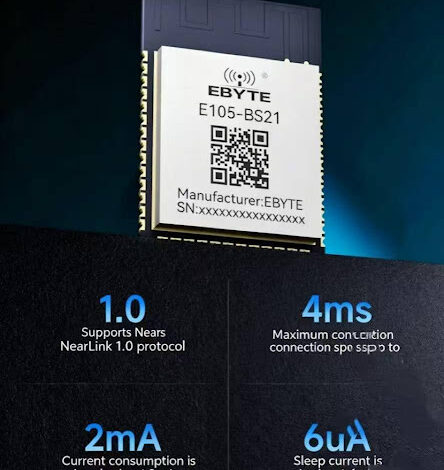
Based on the characteristics of StarScan technology, system architecture requirements, and core compatibility with EBYTE products, focusing on the industrial application of StarScan technology, we recommend the EBYTE E105-BS21 SLE Bluetooth StarScan module. This module is deeply adapted to the StarScan protocol, meeting the core characteristics of SLE low power consumption, high reliability, and low latency. It is suitable for low-power short-range communication scenarios in various fields. Details are as follows:
E105-BS21: This Bluetooth StarScan module is developed based on the StarScan 1.0 protocol, using a PCB antenna to achieve serial-to-SLE low-power StarScan communication. It features small size, ultra-low power consumption, stable transmission, strong anti-interference, and low latency. Operating in the 2.4GHz band with a transmit power of 6dBm, it supports rapid deployment via AT commands and is widely applicable to low-power short-range communication scenarios such as smart wearables, smart homes, automotive, and industrial data acquisition and control.
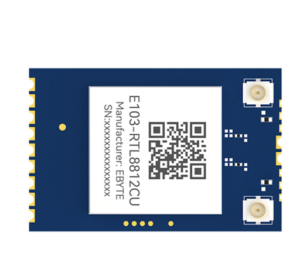
E103 Wi-Fi: Dual-band high-speed Wi-Fi module that can work with the StarSpark SLB high-speed interface to meet high bandwidth requirements such as high-definition screen projection, large file transfer, and smart home gateway.