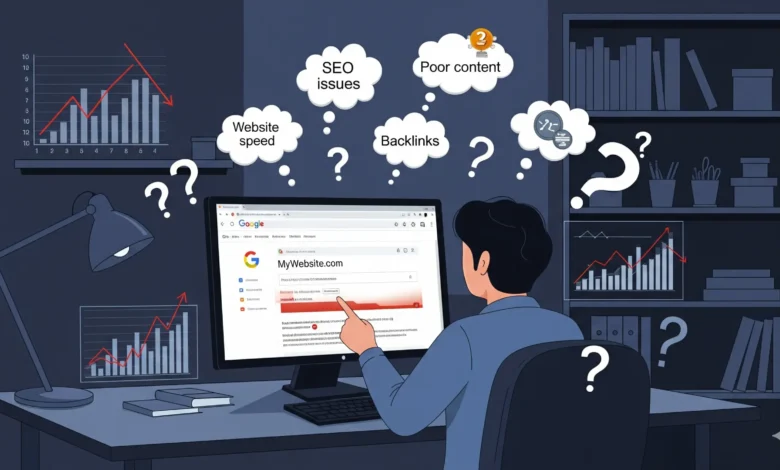
It is a sinking feeling: you’ve put hours into your business, launched a beautiful site, and yet, when you search for your services, you are nowhere to be found. If your website is not ranking on Google, it is keeping you up at night; you aren’t alone. In 2026, the digital space is crowded, and Google’s standards for what deserves a “Page 1” spot have never been higher.
Visibility isn’t a right; it is earned through consistent value and technical health.
If you are seeing a flatline in your analytics, it’s usually not bad luck. It is typically a disconnect between what you are providing and what the algorithm is looking for. Let’s break down the seven hard truths about why your site is stuck in the shadows.
1. You Are Invisible to Crawlers (Indexation Issues)
Sometimes the problem is purely mechanical. If Google can’t “see” your pages, it can’t rank them. This often happens because of a simple “noindex” tag left over from development or a robots.txt file that is accidentally blocking search engines. If you aren’t a technical expert, partnering with a results-driven SEO agency can help you run a diagnostic to ensure your “digital doors” are actually open to the public.
2. Your Content Lacks “Information Gain.”
In 2026, Google is exhausted by “copy-paste” content. If your blog post says the same thing as the top ten results, Google has no reason to rank you. To fix this, you need to add something new, a unique case study, a controversial opinion, or a better way of explaining a complex topic. This “Information Gain” is now a primary requirement for outranking the competition.
3. The “Slow Site” Penalty
Patience is a relic of the past. If your site takes more than three seconds to load, users bounce, and Google notices. Slow loading times, jumpy layouts, and heavy images are common SEO mistakes that signal to Google that your site provides a poor user experience.
4. You’ve Been Hit by a Manual or Algorithmic Penalty
If your traffic suddenly fell off a cliff, you might be facing Google penalties. This could be due to:
- Unnatural Backlinks: Buying cheap links from “link farms.”
- Keyword Stuffing: Trying to hide keywords in white text or overusing them unnaturally.
- Thin Content: Having hundreds of pages with only one or two sentences on them.
Applying low organic traffic fixes usually starts with a deep cleanup of these spammy tactics.
5. Poor Mobile Experience
Nearly 60% of all searches happen on mobile devices. If your site looks great on a laptop but is impossible to navigate on a smartphone, you will never reach the top spots. Google uses “Mobile-First Indexing,” meaning it judges your entire site based on how the mobile version performs.
6. Lack of Topical Authority
You can’t just write one post about a topic and expect to beat an expert. Google looks for “Topical Authority”, proof that your site is a comprehensive resource on a subject. If you want to rank for “organic gardening,” you need dozens of interlinked articles covering seeds, soil, tools, and seasons. One-off posts rarely rank in 2026.
7. Ignoring Search Intent
This is perhaps the most common reason for a website not ranking on Google. If a user searches for “how to fix a tap” (Informational Intent) and your page is just a “Buy Our Taps” sales page (Transactional Intent), Google will not show your site. Your content must solve the specific problem the user is having at that exact moment.
The Path to Recovery: A Quick Comparison
| The Problem | The Impact | The Fix |
| Technical Errors | The site is invisible to bots. | Check Search Console for “Coverage” errors. |
| Boring Content | High bounce rates. | Add original data and personal stories. |
| Bad Backlinks | Risk of Google penalties. | Disavow toxic links and earn organic mentions. |
| Slow Speed | Poor UX signals. | Compress images and use a fast hosting provider. |
Moving the Needle
Fixing a site that won’t rank takes time, but it is entirely possible. It starts with a shift in mindset: stop trying to “beat the algorithm” and start trying to be the most helpful person on the internet for your specific niche.
Many brands find that navigating these waters alone is difficult. Working with a results-driven SEO agency can provide the roadmap needed to turn a stagnant site into a traffic-generating asset. When you align your goals with Google’s goal, satisfying the user, the rankings will eventually follow.
Frequently Asked Questions
Why is my website not ranking on Google even though I have keywords?
Keywords are just one part of the puzzle. If your site has technical errors, slow speed, or low-quality content, keywords alone won’t be enough to secure a top spot.
How do I check if my site has Google penalties?
Go to Google Search Console and check the “Manual Actions” tab. If it says “No issues detected,” you likely aren’t facing a manual penalty, but you could still be suppressed by an algorithmic filter for low-quality content.
What are the fastest low-organic-traffic fixes?
The quickest wins usually involve improving page speed, fixing broken internal links, and updating old content with fresh, relevant information and better headlines.
How long does it take for Google to recognize my SEO changes?
It can take anywhere from a few days to several weeks. Google needs to re-crawl your pages and see that the improvements are consistent before it adjusts your ranking.
Is it possible to rank a brand-new website quickly?
It is difficult because new sites lack “domain age” and trust. The best way to rank fast is to target very specific, low-competition “long-tail” keywords that bigger sites are ignoring.
READ ALSO: The Future of Digital Creativity With AI Video Tools and Meme Content