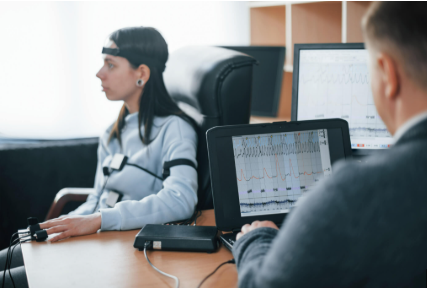
You’ve probably seen a polygraph test in a crime drama. Someone’s sweating bullets, wires clipped to their fingers, a machine recording every twitch of their heartbeat, every rise and fall of their breathing. The tension is almost cinematic. But let’s be honest—the real thing is a bit different, and a lot of people have no idea what actually happens when they sit down in that chair.
I remember the first time I had to witness one, not as a suspect, thankfully, but just observing. The person looked calm on the outside, but the minute the examiner asked them a question about a past incident, you could see the subtle shifts: a quickened pulse, shallow breaths, hands gripping the armrests a little tighter. It’s strange watching human reactions become this visual, measurable data.
How a Polygraph Test Actually Works
Here’s the thing: a polygraph doesn’t read minds. It doesn’t magically reveal truth or lies. What it does is track physical responses—heart rate, blood pressure, respiration, and skin conductivity (basically, how sweaty your palms get). The assumption is simple: when you lie, your body reacts in subtle ways. Your nervous system kicks in, sometimes before your conscious mind even realizes it.
Now, that sounds straightforward, but human bodies aren’t machines. Some people can lie without a blink, while others might get nervous just sitting in a chair being watched. That’s one of the big reasons polygraph results aren’t 100% reliable. You can’t perfectly separate a nervous innocent person from a guilty liar based purely on heart rate spikes.
The Setup: What You’ll Actually Experience
Most people imagine a polygraph room as something straight out of a spy movie—dim lighting, walls full of monitors, the hum of a mysterious machine. The truth is a little more mundane. Usually, it’s just a small office with a chair, a table, and the polygraph machine. The examiner is there, clipboards in hand, ready to guide you through the process.
They’ll start with a pre-test interview. You’ll talk about your background, your habits, and the incident in question. The examiner wants to know you as a person, not just as a “subject.” It’s oddly reassuring at first. They’ll explain the sensors: one around your chest, one on your arm, a couple on your fingers. It’s a bit like a medical check-up, only the stakes feel higher.
Then comes the real test. The examiner will ask a series of questions—some irrelevant, some control questions meant to measure your natural reactions, and then the critical questions about the incident. They’re looking for patterns, not individual spikes.
The Nerves Are Real
Let’s be honest, almost everyone is nervous during a polygraph. Even if you haven’t done anything wrong, the pressure of being “tested” can trigger the same physical responses the machine is measuring. I saw one guy, completely innocent, sweat through his shirt just answering routine questions. It’s fascinating—and a little unfair—how our bodies betray us, even when our minds are calm.
Some people try to outsmart it. You’ve heard the stories: biting your tongue, doing mental math, holding your breath. In reality, examiners are trained to spot these tactics. Plus, if you tense up too much, it can actually make your readings look more suspicious. Irony at its finest.
Misconceptions About Polygraphs
The biggest misconception is that they can catch a lie every time. Hollywood loves to show someone breaking down on the machine after a single “gotcha” question, but real life isn’t that dramatic. Polygraphs are tools, not truth machines. A nervous person can look guilty, and a practiced liar can sometimes skate through.
Another myth is that examiners can somehow “trick” the machine. That’s mostly a Hollywood invention. The real skill is in asking the right questions and interpreting subtle physiological cues, not reading minds.
It’s also worth noting that polygraph results are not always admissible in court. Some states allow them in certain situations, but many courts treat them as unreliable. So if you’re hoping to use a polygraph to prove your innocence, think of it more as a screening tool than a courtroom weapon.
Why Companies and Law Enforcement Still Use Them
Here’s the thing: even with all the controversy, polygraphs are still widely used. Law enforcement agencies use them during investigations, security-clearance processes, and pre-employment screenings for sensitive jobs.
Why? Because, when used properly, they can give investigators valuable insights. It’s less about proving guilt and more about highlighting inconsistencies that warrant further investigation. Think of it as a conversation starter rather than a verdict.
In some workplaces, companies use them to screen candidates in roles with high stakes—handling money, confidential information, or sensitive tech. Again, the polygraph isn’t deciding who gets hired; it’s helping employers dig a little deeper.
What It Feels Like Emotionally
Sitting in a polygraph isn’t just about wires and machines—it’s a psychological experience. Time slows down. You become hyper-aware of every twitch, every heartbeat. Even innocuous questions feel loaded. One person I observed kept fidgeting with their watch, not realizing their small movements were being noted as part of the baseline.
For many, the most stressful part isn’t the questions themselves, but the idea of being judged by a machine. It’s an odd mix of vulnerability and performance pressure. You’re forced to confront your own reactions in a way most of us never do.
Tips If You Ever Have to Take One
First, relax as much as possible. Easier said than done, right? But your baseline responses matter more than you think. If you’re calm during the control questions, examiners have a better chance of interpreting your responses accurately.
Second, be honest. Sounds obvious, but it’s tempting to try to “game” the system. Not only is it risky, it can backfire. Trying to force yourself to appear normal can make your reactions more erratic, not less.
Finally, treat the examiner like a human, not an adversary. They’re trained professionals, and most genuinely want to get accurate readings. Being cooperative and calm helps more than any trick or strategy.
The Takeaway
Polygraphs are fascinating because they sit at the intersection of psychology, physiology, and human behavior. They reveal how our bodies can betray our minds and how subtle patterns can be interpreted—sometimes accurately, sometimes not. They’re not perfect truth detectors, but they’re still useful tools for investigators and employers when used carefully.
At the end of the day, the polygraph test is as much about perception as it is about physiology. Sitting in that chair, feeling your heart race, realizing how transparent your body can be—it’s a reminder that humans are complex creatures. We think we can control ourselves, but our bodies often tell a different story.
And honestly, that’s what makes the whole process so fascinating. Whether you’re taking one, observing one, or just curious, it’s a glimpse into the way truth and deception play out in real life.