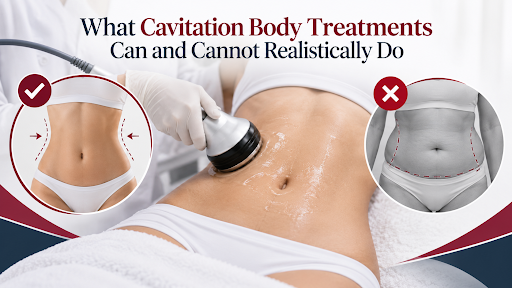
Ultrasonic cavitation is a body contouring treatment, not a weight loss method, and that single distinction explains most of the disappointment people feel when results fall short of the marketing. The technology is designed to reduce the appearance of small, stubborn fat pockets in a specific area, so a realistic goal is a smoother contour on a body that is already close to its target weight, rather than a lower number on the scale.
Much of the confusion starts with how cavitation slimming devices are described. They use low frequency ultrasound to disturb fat cell membranes so that some of their contents are released and then processed by the body. That mechanism can refine a stubborn area over a course of sessions, but it does not shrink the whole body, and it does nothing to address the eating and activity patterns that put fat there in the first place.
How the treatment acts on fat
During a session a handheld applicator delivers ultrasound energy into the tissue just under the skin. The pressure waves are meant to disrupt the walls of fat cells in the treated zone, and the released material is gradually cleared through the lymphatic system and metabolized by the body. Because the effect is limited to the area under the applicator, cavitation is used to shape defined regions such as the abdomen, hips, thighs, upper arms or flanks rather than to reduce fat everywhere at once.
A single visit rarely produces a visible change. The clearing process is gradual, and providers usually plan a course of several sessions spaced roughly a week apart so the body has time to process fat from one treatment before the next. Sessions themselves are short, commonly lasting under an hour, and most people feel only warmth and a faint buzzing rather than pain.
What a full course can realistically achieve
The honest answer is a modest, localized reduction rather than a dramatic transformation. The clinical evidence is still limited, and effectiveness varies from person to person, so the treatment is best understood through directional findings rather than guarantees. In one small study, participants who received three treatments saw the treated fat area reduced by roughly one to three centimeters, and importantly they lost fat in that zone without losing overall body weight. Other trials on non invasive ultrasound have reported measurable reductions in waist circumference over a course of sessions, and at least one randomized study found that adding focused ultrasound to regular aerobic exercise produced a greater waist reduction than exercise on its own.
The pattern across these findings is consistent. Cavitation can trim a targeted area by a few centimeters when it is done as a series and paired with a stable, active lifestyle. It is a refinement tool, and treating it as anything more sets up expectations the technology cannot meet.
The limits that marketing tends to skip
Cavitation is not a substitute for weight loss and is not suitable for treating obesity. The best candidates are people in good general health who are already within a narrow margin of their goal weight, do not smoke, and want to address a specific area that has resisted diet and exercise. Someone hoping to lose a large amount of fat will not get there with cavitation.
- It cannot remove large volumes of fat or reshape the entire body.
- It does not tighten significant loose skin, and in some cases the skin over a treated area heals unevenly.
- Fat cells that shrink can store fat again if weight is regained, so results are not permanent on their own.
- Home devices tend to run at lower power than clinic equipment, so their effect is usually weaker and less predictable.
Side effects are generally mild and short lived, most often temporary redness, bruising or a headache after a session, with occasional lumpiness where fat is reabsorbed unevenly. As with any body treatment, it is not appropriate for everyone, and people who are pregnant or who have relevant medical conditions should speak with a qualified provider before starting.
Why lifestyle decides the outcome
This is the part that determines whether a course is worth the money. Cavitation releases fat from cells in a treated area, but the body still has to clear and burn that material, and it will store it again if daily energy intake stays too high. That is why providers emphasize drinking plenty of water and staying active around the treatment window, and why results hold up far better for people who keep their weight stable afterward.
In practice the treatment works with your habits, not instead of them. A balanced diet and regular movement give the body a reason to use the released fat and prevent new fat from filling the same pocket. Without that foundation, even a well delivered course tends to fade. With it, cavitation becomes a way to polish a contour that steady eating and exercise have already brought most of the way.
Clinic sessions versus at-home devices
Both routes exist, and the trade off is straightforward. A trained provider in a clinic uses higher powered equipment, assesses whether you are a suitable candidate, and can manage the area and expectations. At-home units are more affordable and convenient, but their lower output means slower, less reliable results, and there is no professional judgment about whether the treatment suits you at all.
| Factor | Clinic treatment | At-home device |
| Power | Higher, professional grade | Lower, consumer grade |
| Guidance | Provider assessment and aftercare | Self directed, no screening |
| Typical result | More consistent over a course | Weaker and more variable |
| Cost | Higher per course | Lower upfront, ongoing effort |
Neither option changes the core rule. Whichever path you choose, cavitation performs best as a targeted finishing step for someone near their goal weight who is willing to support the treatment with hydration, sensible eating and movement. Judged that way, it can genuinely refine a stubborn area. Judged as a shortcut to weight loss, it will almost always disappoint.