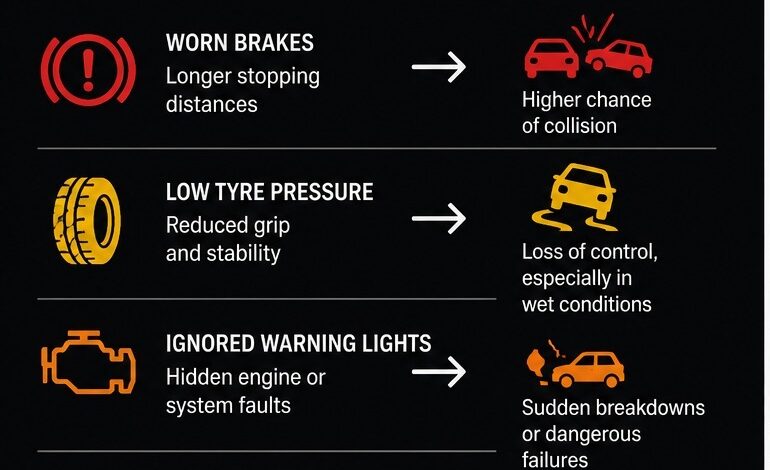
Small car faults can turn dangerous fast. Find out how minor mechanical issues create major safety risks and why timely repairs matter in Aldershot.
Most drivers do not set out to ignore their car. It tends to happen gradually. A squeal from the brakes that appears occasionally, a chip in the windscreen that has been there for months, a warning light that flicks on and off without seeming to cause any real problem. These things get noted, they get filed away mentally as something to look at later, and life continues. The trouble is, later has a way of arriving unexpectedly, and sometimes at exactly the wrong moment.
Vehicle defects contributed to over 1,200 road accidents in the UK in a single year, according to data from the Department for Transport. That number represents real people, real consequences, and in many cases, faults that had been present long before the moment they mattered. The connection between a small mechanical issue and a serious safety outcome is not theoretical. It is well documented. If you notice any changes in how your car behaves, checking the 10 warning signs your car needs immediate repairs is a useful starting point before things escalate.
Why Small Problems Do Not Stay Small
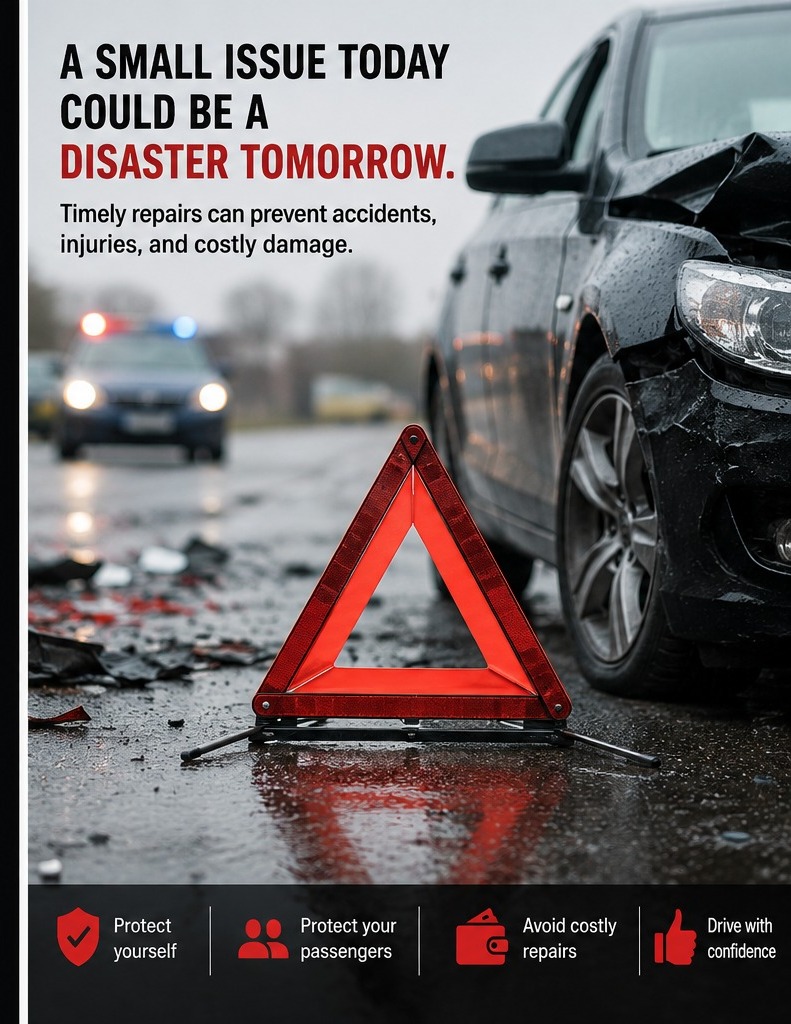
There is a natural human tendency to measure risk by how something feels rather than by what is actually happening. A car that pulls slightly to the left on a straight road still gets from A to B. An engine that takes a little longer to warm up still starts. Brakes that squeal briefly before catching still stop the car. These observations are all true in the short term, and that is precisely what makes them dangerous.
Mechanical systems in a car do not operate in isolation. One failing component places additional stress on the components around it. A worn brake pad does not simply reduce stopping power, it scores the disc, strains the calliper, stresses the brake lines, and eventually compromises the hydraulic system. What could have been resolved with a pad replacement becomes a far more significant repair, and somewhere along that journey from minor to major, the window in which a failure can occur on the road opens up considerably.
The same pattern repeats across almost every system in the vehicle. Small issues escalate because they are allowed to, and the cost is always higher, whether measured in money, time, or safety, when action is delayed.
The 5 Mechanical Issues That Turn Dangerous Fastest
1. Worn Brake Pads
Brakes are the single most safety-critical system on any vehicle. They are also one of the systems where the gap between noticing a problem and facing a serious safety risk is shortest. When brake pads wear down, the friction material that creates stopping power diminishes. The car takes longer to stop. In a controlled situation on a clear road, a driver may not notice the difference. In an emergency, at speed, or in wet conditions, that difference in stopping distance can be decisive.
The warning signs are usually audible before they become dangerous. A high-pitched squeal when braking is often the wear indicator making contact with the disc, a deliberate design signal that the pad is nearing the end of its life. Ignore it long enough and the squeal becomes a grinding sound, which means metal-on-metal contact is already occurring. At that point, the disc is being scored with every stop. The calliper may begin to overheat and seize. Brake fluid can boil under sustained heat load, causing the pedal to feel soft or to sink toward the floor.
At the extreme end, complete brake failure becomes a real possibility. A fault that could have been resolved with a straightforward pad replacement becomes a situation involving new discs, callipers, and potentially brake lines, at a cost several times greater and with the additional risk of a dangerous moment on the road.
2. Suspension Wear
Suspension is the system that keeps your tyres in contact with the road. It absorbs the energy from bumps, potholes, and uneven surfaces, distributes that energy away from the chassis and the driver, and allows the car to maintain directional stability under braking and cornering. When it is working well, it is invisible. When it starts to fail, the car begins to feel vague, uncertain, and harder to place accurately on the road.
Worn shock absorbers, ball joints, control arm bushings, or anti-roll bar links all degrade the car’s ability to respond predictably. A car with compromised suspension takes longer to stop because tyre contact with the road becomes inconsistent. It can feel unpredictable over uneven surfaces, particularly at higher speeds. In the event of an emergency manoeuvre, the reduced stability becomes a significant factor.
The deterioration is usually gradual, which is part of the problem. A driver adjusts to a slightly bouncier ride, or slightly softer steering feel, without identifying it as a change in the safety characteristics of the car. By the time the issue becomes obvious, it has often been present for a considerable period and may have already affected other components including tyres, steering geometry, and braking performance.
3. Steering Component Wear
Wear in steering components tends to develop slowly and quietly. Track rod ends, ball joints, and steering rack components all experience wear over time, particularly in vehicles that cover higher mileages or are driven frequently on poorer road surfaces. The result is play in the steering, a slight looseness between what the driver inputs and what the wheels actually do.
In normal driving, a small amount of play can be compensated for instinctively. On a motorway at speed, or when a sudden hazard requires a sharp directional change, that compensation disappears. The car does not respond as expected. A steering rack that has developed excessive play can in a worst case fail to transmit driver input to the front wheels, effectively removing directional control.
The signs to act on include a steering wheel that feels looser than usual, a knocking or clunking sensation when turning at low speed, or the car feeling less direct and planted on faster roads. None of these are minor inconveniences. They are early indicators of a system under stress.
4. A Cracked or Chipped Windscreen
A windscreen chip is easy to dismiss. It is not making a noise, it is not changing how the car drives, and it often stays in a position where the driver barely notices it. That sense of inconsequence is misleading.
The windscreen serves multiple structural and safety functions beyond simply providing a view ahead. It forms part of the vehicle’s structural rigidity. In a front-end collision, a properly intact windscreen helps prevent the roof from collapsing. It also acts as a backstop for the passenger airbag, which deploys upward and uses the glass as a surface to direct the bag toward the occupant. A compromised windscreen can fail at exactly the moment it is needed most.
From a visibility standpoint, even a small chip in the driver’s direct line of sight can create glare, distortion, and refraction that is most acute in low sun or when facing oncoming headlights at night. UK law is clear on this. A crack of more than 10mm in the swept zone directly in front of the steering wheel is an MOT failure, and driving with windscreen damage that impairs vision can result in penalty points and a fine.
Chips almost always spread under temperature changes, vibration, and the pressure of daily driving. A chip that is repairable today becomes a crack that requires full replacement next month. Addressing it early is almost always significantly cheaper and removes a safety variable entirely.
5. Worn Wiper Blades
Wiper blades sit low on most drivers’ mental priority lists. They are often only thought about at the moment they are needed, and by then the problem is already present. Rubber degrades over time from UV exposure, temperature fluctuations, and the general abrasion of sweeping across glass. Blades that leave streaks, miss sections of the screen, or chatter across the glass are not doing their job.
In clear weather this is a minor irritation. In a sudden downpour on a Hampshire road, or when spray from a motorway lorry hits the screen, compromised wipers can reduce visibility to an unsafe level within seconds. The driver is suddenly making decisions with significantly less visual information than they expect, at speed, with other traffic around them.
UK law requires wipers to be in working order. Defective blades are an MOT failure point, and driving with impaired visibility can constitute an offence under the Road Traffic Act. The fix is inexpensive and takes minutes. The risk of leaving it is real and entirely unnecessary.
How Faults Compound: A Cascade Effect
One of the less obvious aspects of mechanical neglect is the way in which one fault creates conditions for others to develop. Here is a straightforward illustration of how this plays out in a real vehicle:
| Initial Fault | Secondary Effect | Tertiary Effect |
| Worn brake pads | Scored brake discs | Overheated callipers, potential fluid boil |
| Worn suspension | Uneven tyre wear | Reduced braking grip, steering instability |
| Steering play | Uneven tyre scrub | Alignment drift, increased fuel consumption |
| Windscreen chip | Crack development | Structural compromise, visibility failure |
| Worn wipers | Streaking in rain | Compromised reaction time, increased accident risk |
None of these chains begin with a catastrophic event. They begin with a small fault that was allowed to continue.
What to Watch for Between Services
Staying across the condition of your car between service appointments does not require mechanical knowledge. It requires attention to how the car feels, sounds, and behaves. Changes in any of these are worth noting and worth acting on.
The following are the most important things to monitor regularly:
- Listen for any new sounds when braking, turning, or going over bumps.
- Notice if the steering feels looser, heavier, or less direct than usual.
- Check wiper blade performance the next time it rains and replace them if streaking occurs.
- Inspect the windscreen periodically, particularly after a long motorway run or a cold spell.
- Check tyre pressures monthly and look for any uneven wear patterns across the tread.
- Act on any dashboard warning light rather than waiting to see if it clears on its own.
- Pay attention to how the car feels when braking at speed and whether it pulls to one side.
If any of the above feel relevant to your car right now, it is also worth reviewing the 9 signs your car is overdue for a service as a checklist of where things stand.
The Relationship Between Servicing and Safety
Regular servicing is not purely a matter of maintaining performance or protecting the resale value of a car, though it does both. It is the primary mechanism by which small faults are identified before they become large ones. A trained technician inspecting a vehicle during a service will check brake pad depth, assess suspension play, inspect steering components, and look for fluid levels and leaks that a driver is unlikely to spot.
Research from the UK warranty sector found that approximately one in three drivers has experienced a sudden mechanical or electrical failure. That figure represents vehicles that reached the point of failure without the issue being caught earlier. The majority of those failures will have been preceded by smaller signs that either were not noticed or were not acted on.
For drivers across Aldershot, Farnborough, Fleet, Farnham, and the surrounding areas of Hampshire, booking consistent car servicing in Aldershot provides that regular opportunity to catch faults early, before the cascade described above has a chance to develop.
Conclusion
Small mechanical issues are not small in consequence. A worn pad, a steering knock, a windscreen chip, a degraded wiper blade, these things do not announce themselves as safety hazards. They present as inconveniences, and that is exactly why they are allowed to develop into something more serious. The gap between a minor fault and a dangerous situation is often much smaller than it feels when things are still running, and the cost of addressing a fault at the early stage is almost always a fraction of what it becomes if it is left.
Paying attention to your car, acting on the signals it gives you, and maintaining a consistent service schedule are not excessive precautions. They are the practical, everyday habits that keep a vehicle safe to drive and keep the people inside it, and around it, out of harm’s way.
Frequently Asked Questions
Can a small mechanical fault really cause a serious accident? Yes. Vehicle defects contributed to over 1,200 road accidents in the UK in a single year according to Department for Transport data. Many of those defects began as minor faults that were present long before the incident occurred.
How quickly can worn brake pads become dangerous? Worn brake pads increase stopping distances immediately, even at early stages of wear. Once metal-on-metal contact begins, the risk of brake fade and calliper damage escalates quickly, and the potential for brake failure in an emergency increases significantly.
Is a small windscreen chip actually a safety risk? Yes. A chip in the driver’s direct sightline creates glare and distortion in certain light conditions. It also weakens the structural integrity of the glass and almost always spreads over time due to temperature changes and road vibration.
How often should wiper blades be replaced? Wiper blades typically last six to twelve months under normal UK conditions. If they streak, chatter, or leave dry patches on the screen in rain, they should be replaced regardless of how recently they were fitted.
What are the early signs that suspension is wearing out? Common early indicators include a bouncy or unsettled ride over bumps, a knocking or creaking sound from the corners of the car, uneven tyre wear, and vague or less responsive steering feel, particularly on faster roads.
Why does one fault often lead to others? Car systems are interconnected. Worn brakes strain discs, callipers, and brake fluid. Worn suspension causes uneven tyre wear and places extra load on steering components. Leaving one fault unaddressed creates the conditions for a secondary fault to develop, often at greater cost.