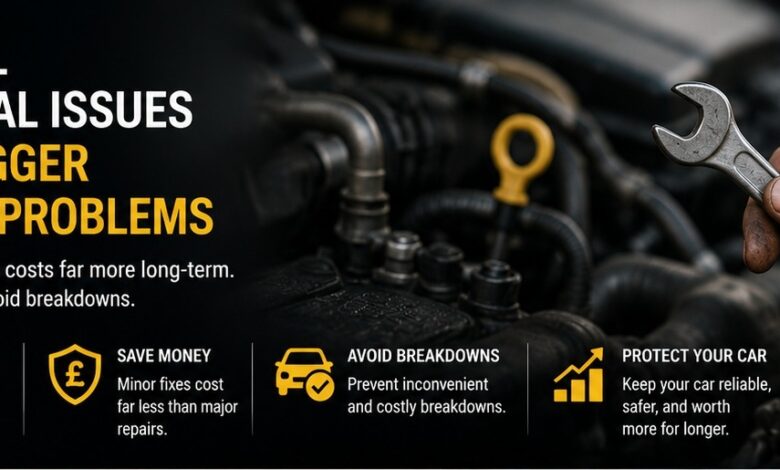
Ignoring minor car faults costs far more long-term. Discover how small mechanical issues escalate fast and what Guildford drivers can do to stop them.
Most expensive car repairs do not arrive without warning. They build slowly, quietly, from something you noticed weeks or even months earlier and decided to deal with later. A faint squeal when braking. A slight vibration at speed. A dashboard light that appeared once and then vanished. Small things, easy to push down the priority list when life is busy and the car still seems to be running.
The difficulty is that cars are designed to keep functioning even when something is beginning to fail. One of the most common reasons car problems become expensive is simple: the car still works. Drivers often assume that if the vehicle is running, there is no urgent issue. But cars are designed to keep functioning even when something is starting to fail. This creates a false sense of security.
For drivers in Guildford and the surrounding areas, that false sense of security is where the real financial risk lies. Understanding how small faults escalate, and why acting early is so much cheaper than acting late, is one of the most practical things any driver can know.
The Pattern Behind Every Expensive Repair Bill
There is a pattern that mechanics see repeatedly. A driver comes in with a serious problem. When they trace the history, there were earlier, much cheaper warning signs that were ignored. Many expensive repairs begin as small issues. Worn tyres, neglected suspension components, or ignored warning lights often lead to secondary damage. A simple monthly inspection can prevent more serious problems from developing.
The reason small problems become big ones is not complicated. Most mechanical systems in a car are interconnected. When one component begins to fail, it places additional stress on the parts around it. Those parts then wear faster than they should, and the damage compounds. By the time it becomes impossible to ignore, the original fault has already taken other components with it.
Real Examples of Small Faults That Became Expensive Problems
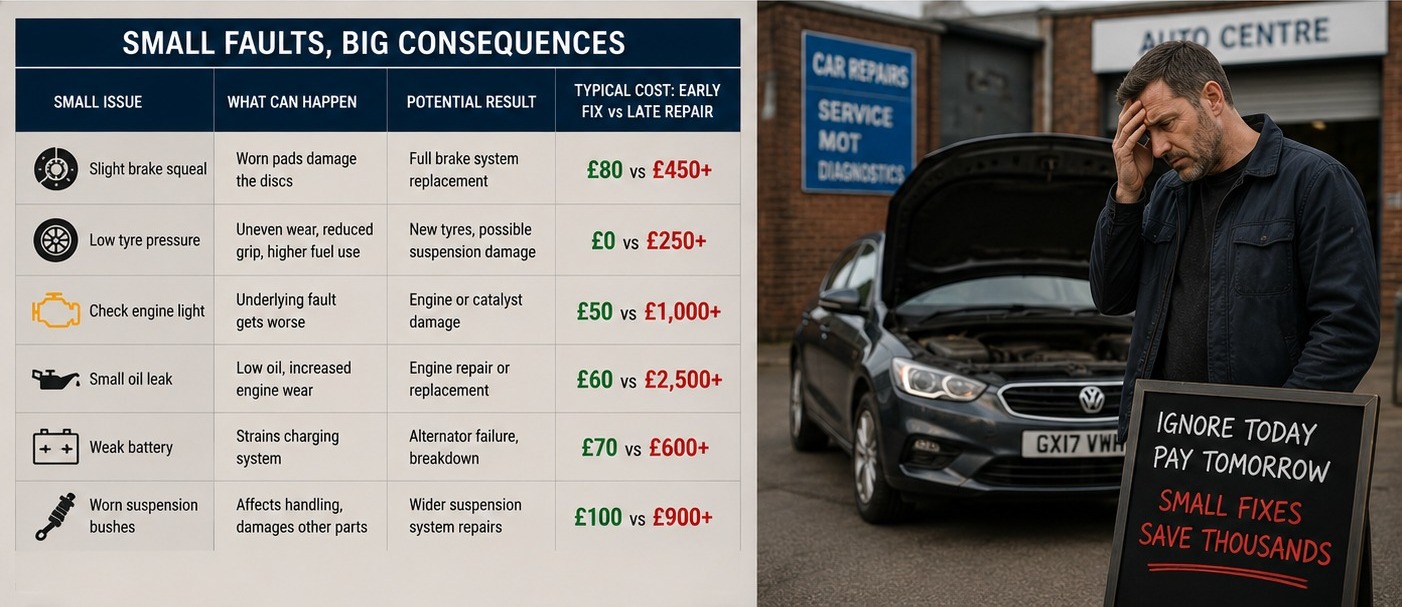
Worn Brake Pads Left Too Long
Brake pads are a consumable part. They wear gradually over time and give clear, audible warnings when they need replacing. That high-pitched squeal when you press the pedal approaching a junction or a roundabout is not a random noise. It is the wear indicator built into the pad making contact with the disc, specifically to tell you that replacement is due.
Ignoring worn pads can damage the brake discs, leading to more expensive repairs. Many UK drivers only notice the issue when the noise becomes unavoidable, by which point the discs may already be affected.
What was a £120 job can quietly evolve into a £400 or more repair, with stopping power seriously compromised along the way. And it does not end there. A failing brake system forces the ABS to work harder than it was designed to, sometimes leading to sensor or pump failure. These repairs can cost thousands, far more than simple pad maintenance.
The squeal is a gift. It is giving you the cheapest possible opportunity to fix the problem. Ignoring it turns a pad replacement into a disc replacement, and potentially a calliper and ABS sensor replacement too.
A Small Coolant Leak Ignored
A drip of coolant beneath the car or a gradually falling coolant level might seem minor, especially if the temperature gauge appears normal. But cooling system leaks rarely stay small. A repair that might cost £150 to £200 for a hose today could easily escalate into a £900 or more water pump or head gasket repair if ignored.
A cooling system flush costs £60 to £100. A head gasket replacement costs ten times that. If the head gasket fails and the situation continues, the cylinder head can warp, turning a £1,000 repair into a £3,000 one. In the most severe cases, the engine block itself can crack, and at that point the vehicle may be beyond economical repair entirely.
A small hose replacement is a straightforward job. The financial trajectory from ignoring it is anything but.
The Timing Belt Nobody Replaced
The timing belt, also known as the cambelt, is one of the few components that gives no warning before it fails. It simply snaps. When it does, the damage is immediate and severe. Valves and pistons can collide inside the engine, causing destruction that often requires a complete engine rebuild or replacement. Economy cars average £415 to £785 for a timing belt replacement. Mid-range cars range from £660 to £1,070, and luxury vehicles can reach £985 to £1,540 or more. That is the cost of doing it on schedule. The cost of not doing it at all can exceed the value of the car.
Every manufacturer specifies a replacement interval in the owner’s manual. It is one of the clearest and most affordable ways to prevent a catastrophic repair.
An Engine Noise Left Uninvestigated
A gentle tick can signal low oil, worn lifters, or timing issues. Leave it long enough and you move from a cheap oil and filter change to damaged camshafts or even a ruined engine. Noise is often just friction given a voice. Where metal touches metal without enough protection, sound is the early warning before heat and wear take over.
Engine knocking, ticking, or rattling at idle are signals that something is not being lubricated properly, or that components are wearing against each other without the protection they need. Investigating strange noises early is always the right decision. Understanding why your car is making strange noises is a useful first step in knowing what warrants urgent attention and what can wait.
A Suspension Bush That Was Never Replaced
Suspension components wear gradually and the early signs are easy to dismiss. A slight knocking over speed bumps. Slightly heavier steering. The car feeling less planted than it once did. A small worn bushing or shock absorber issue gradually affects other parts of the system. Over time, this leads to uneven tyre wear, poor handling, and more expensive full suspension replacements.
Individual bushings and shock absorbers are relatively inexpensive to replace. Full suspension overhauls, required when the damage has spread, are substantially more costly and also affect your tyres, wheel alignment, and the handling behaviour of the vehicle.
Why Drivers Delay and Why It Costs More Every Time
The reasons drivers delay acting on mechanical warnings are understandable. Repairs feel inconvenient. The car is still moving. There is always something more pressing to spend money on. But the financial logic of delaying runs in the wrong direction entirely.
Warning lights are basically the car saying, sort me now while it is still cheap. The expensive repair comes when the real cause keeps getting worse until it takes something bigger with it.
Every week a fault goes unaddressed, the window for the cheap repair narrows. The component that was borderline definitively failed. The part it has been stressing crosses its own threshold. The repair that was a single-line invoice becomes a multi-page one.
How Routine Servicing Breaks This Cycle
The most effective way to prevent small mechanical issues from becoming large financial ones is consistent, professional maintenance. A full car service is not just an oil change. It is a structured inspection of the systems most likely to develop faults, carried out by someone who knows what developing problems look like before they become visible to the driver.
During a full service, a technician will typically check:
- Brake pad and disc thickness, including calliper condition
- Coolant levels, hoses, and cooling system integrity
- Engine oil condition and level
- Air filter and fuel system components
- Steering and suspension components
- Tyre condition, tread depth, and pressure
- Battery health and electrical connections
- Timing belt condition, where applicable
Each of these checks costs far less to resolve at the service stage than after the fault has progressed. The service is not an expense. It is financial protection against a much larger one.
The MOT Is Not a Substitute for Maintenance
A common misconception is that passing an MOT means a car is in good mechanical health. The MOT tests whether a vehicle meets minimum legal roadworthiness standards on the day it is assessed. It does not evaluate the overall condition of every system, and it is not designed to catch faults in their early stages.
Plenty of components can be well within MOT parameters while still being close to failure. Brake pads at two millimetres will pass the test but may need replacing within weeks. A coolant hose showing early perishing will not be flagged, but it is already telling a story.
Relying solely on the annual test to identify problems means your car spends most of the year with faults that have not yet been caught. If you are approaching your test date and have concerns about whether your car will pass, it is worth knowing that there is a last-minute MOT option in Guildford available when time is short.
A Practical Guide to Staying Ahead of Faults
You do not need to be a mechanic to meaningfully reduce the risk of a large, unexpected repair bill. A few consistent habits make a significant difference.
- Check your fluids monthly. Engine oil, coolant, brake fluid, and power steering fluid can all be checked visually in under five minutes. A dropping level tells you something before it becomes a problem.
- Listen to your car. New noises are almost always meaningful. A squeal, knock, tick, or grinding sound that was not there last week is worth investigating promptly.
- Trust your tyres. Uneven wear patterns on tyres are often the first visible sign of a suspension or alignment problem. Check them regularly and rotate as recommended.
- Act on warning lights immediately. A warning light is the car’s most direct communication. Ignoring it does not make the underlying issue less serious. It makes it more expensive.
- Keep a service record. Knowing what has been done and when allows both you and your garage to spot gaps and plan ahead before components reach the end of their life.
- Book a service on schedule. Do not wait until something goes wrong to visit the garage. The service interval exists precisely to catch developing problems at the stage where they are still manageable.
What a Full Service Costs Versus What Ignoring Problems Costs
The contrast in costs is significant enough to illustrate directly.
| Minor Issue Caught Early | Approximate Cost | Same Issue Left Too Long | Approximate Cost |
| Brake pad replacement | £80 to £150 | Pads plus disc replacement | £300 to £500 |
| Coolant hose replacement | £150 to £200 | Head gasket replacement | £900 to £1,500 |
| Timing belt replacement | £415 to £800 | Engine rebuild after snap | £2,000 or more |
| Oil top-up and filter change | £60 to £100 | Camshaft or engine damage | £1,500 to £4,000 |
These figures are approximate and will vary by vehicle, but the direction is consistent in every case. Catching the problem early costs a fraction of catching it late.
Conclusion
There is a straightforward financial argument for staying on top of your car’s maintenance, and it is this: the cost of prevention is always lower than the cost of the problem it prevents. Small mechanical faults are not just inconveniences. They are the early stages of larger, more expensive ones. Catching them in the first chapter is incomparably cheaper than waiting until the final one.
For drivers in Guildford and the surrounding areas, booking a car MOT in Guildford and keeping up with full service intervals are the two simplest and most effective things you can do to protect both your vehicle and your finances. Your car is telling you things all the time. Listening early is what keeps the cost manageable.
Frequently Asked Questions
How quickly can a small car problem become an expensive one? It varies by component, but some faults escalate very quickly. Brake pads that squeal today can be grinding against discs within a few weeks. A small coolant leak can lead to head gasket failure within months if driving continues. The sooner action is taken, the cheaper the outcome.
Is it safe to drive with a minor fault if the car seems to be running normally? Not always. Many serious faults develop while the car continues to run. The engine, braking system, and cooling system in particular can sustain significant internal damage that is not immediately apparent in how the car drives. A professional inspection is the only reliable way to assess the actual condition.
How often should I book a full service? For most vehicles, a full service is recommended every 12,000 miles or once a year, whichever comes first. Your owner’s manual will specify the exact interval for your vehicle. Higher mileage drivers or those with older vehicles may benefit from more frequent checks.
Can a car pass its MOT but still have developing faults? Yes. The MOT tests against minimum legal standards on the day of the test. Components can be within the required limits while still being close to failure. Routine servicing between MOT dates is what catches those developing issues before they become failures.
What is the single most important thing I can do to avoid large repair bills? Book your car in for a full service on schedule and act on any unusual sounds, smells, or warning lights promptly rather than monitoring them over time. Early investigation costs a fraction of late investigation in almost every case.