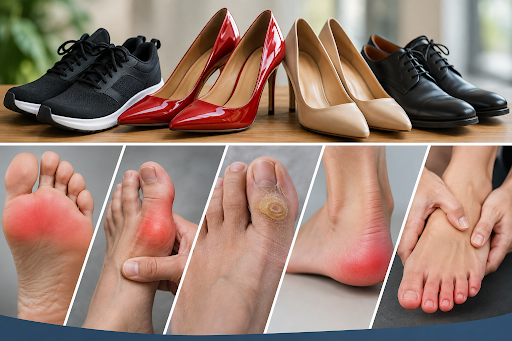
Here’s an uncomfortable experiment. Take off your shoe, place it sole-up on a piece of paper and trace around it. Now stand on the paper and trace your bare foot over the outline.
For most people, the foot drawing spills over the shoe drawing in exactly one place: the toes.
We spend decades walking around inside that mismatch, and then wonder why feet are among the most complained-about body parts in middle age. The link between narrow footwear and foot trouble isn’t controversial in medical circles. It’s just spectacularly under-discussed everywhere else — partly because shoes are sold as fashion rather than equipment, and partly because the damage arrives so slowly that nobody can point at the day it started.
The mismatch, in numbers
A human foot is widest across the toes. Almost every mass-market shoe is widest across the ball of the foot and tapers to a point somewhere ahead of it. The gap between those two shapes is usually only a centimetre or two.
But you take somewhere in the region of five to seven thousand steps a day, and over a lifetime you’ll cover well over a hundred thousand miles — several laps of the planet, on the same two feet. Small forces, applied that many times, do big things. That’s not alarmism; it’s just arithmetic.
It’s also why the effect is so easy to miss. Nobody’s foot is deformed by a pair of shoes in a fortnight. It happens across thirty years, which is precisely the timescale at which humans are worst at noticing anything.
The slow mechanics of the squeeze
The big toe drifts inward. Pressed continually towards its neighbours, the big toe gradually angles across the foot, straining the joint at its base. That’s the classic mechanical setup for a bunion — the bony bump that a widely cited review of the research put at around a quarter of working-age adults, rising to roughly a third in the over-65s, and affecting women disproportionately. Genetics load the gun here; footwear is very good at pulling the trigger.
Toes learn helplessness. Toes exist to grip, splay and push off. Bundled into a point, they can’t do any of it — and like any body part relieved of its duties, they weaken. Weak toes mean poorer balance, a quieter push-off, and more of the work shunted upstairs to knees and hips.
The forefoot takes the bill. Concentrating your body weight onto a narrower platform raises the pressure under the ball of the foot. Burning forefoot pain, thickened nerve tissue between the metatarsals (Morton’s neuroma) and calluses in odd places all trace back, in a great many cases, to simple real estate: too much foot, too little shoe.
Skin and nails pay too. Ingrown toenails, corns between the toes and the little toe that curls under its neighbour are not random misfortunes. They’re pressure injuries, and pressure is a shape problem.
Balance gets muted. The soles of your feet are dense with nerve endings that feed your balance system a constant stream of information about the ground. Stiff, tight shoes muffle that signal. It’s a minor nuisance at thirty. It’s a genuine contributor to fall risk at seventy, which is when falls stop being embarrassing and start being serious.
What a foot is actually designed to do
It helps to know what’s being prevented.
A healthy foot is not a passive platform. On landing, it spreads — the arch lowers, the toes splay, the whole structure widens to absorb load. Then, on push-off, it stiffens back into a lever, largely thanks to the big toe extending and drawing the tissue under the arch tight. Anatomists call it the windlass mechanism, and it is genuinely elegant: the same structure switches from shock absorber to spring, twice per step, several thousand times a day.
Both halves of that need room. A foot that can’t spread on landing absorbs badly; a big toe that can’t extend properly springs badly. A narrow toe box interferes with both, which is why footwear shape shows up in complaints far from the foot itself — in shins, knees, hips and lower backs.
Signs your shoes are the culprit
- Red pressure marks along the sides of your toes when you undress at night
- A little toe that folds under, or angles sharply inward towards the others
- Regular pins and needles in the forefoot on long days
- Calluses on the sides of toes rather than under the sole
- Toenails that bruise, thicken, or repeatedly grow in
- Wear on the upper of the shoe — a bulge or stretched patch at the widest point — which means your foot has been arguing with that shoe since the day you bought it
- Relief. Instant, slightly embarrassing relief, the moment you kick your shoes off
None of these proves disaster. All of them are your feet filing feedback, and feet are famously patient about it — they compensate quietly for years, right up until they don’t.
The fair counter-argument
Honesty matters more than a tidy narrative here, so: shoes are not the only villain.
Bunions have a strong hereditary component — plenty of people develop them in sensible footwear, and habitually barefoot populations aren’t entirely free of them either. Body weight, hypermobility, occupation and previous injury all play a part. And plenty of foot pain has nothing to do with width at all: plantar heel pain, tendon problems and stress injuries have their own causes and their own treatments.
What the evidence does support is narrower and more useful: footwear shape is one of the few factors on that list you can change this month, and changing it tends to make the others more manageable rather than less. A wide toe box is not a cure. It’s the removal of an obstacle.
What the evidence supports doing
The encouraging part is that feet respond to better conditions at almost any age. Muscle is muscle, and it re-recruits when asked.
Get the width right. Podiatrists’ most-repeated advice is also the simplest: buy shoes shaped like feet. There’s now a whole category of foot shaped shoes built on anatomical lasts — widest at the toes, straight along the inside edge, so your big toe points forwards rather than inwards, with a flexible sole and a level base that lets the foot work rather than holding it still. Whichever brand you consider, test it against your own foot with the trace method above. The paper doesn’t care about marketing.
Free your feet daily. Barefoot time at home is free physiotherapy: toes spread, the small muscles work, and the skin starts reporting the ground again. Ten minutes on a hard floor does more than most gadgets sold for the purpose.
Train the toes. Two exercises with real evidence behind them: scrunching a towel towards you with your toes, and “toe yoga” — lifting the big toe while the other four stay down, then reversing it. Both are comically hard at first. That difficulty is the finding.
Let the shoe do some of the work. Research on minimally structured footwear suggests that simply walking in shoes that allow the foot to move can build foot muscle strength over a matter of months — in at least one trial, comparably to a dedicated exercise programme. Which is a rather appealing form of training, given that it consists of walking about as usual.
Shop in the afternoon. Feet swell across the day. Shoes bought at 10 a.m. fit a foot that no longer exists by 4 p.m. Wear the socks you actually use, and try both feet — most people have one that’s slightly larger, and that’s the one that should decide the size.
Fit snug, not roomy. Width and length aren’t the same conversation. Your foot should fill the footbed with the arch sitting where your arch actually is; going up a size to escape a narrow toe box just gives you a longer narrow shoe. If you’re genuinely between sizes, size up — but fix the width first.
Take pain seriously. Persistent foot pain, numbness or a rapidly changing toe joint deserve a professional opinion — a podiatrist, not a search engine.
“Wide fit” is not the same thing
This trips up almost everybody, and it’s worth spelling out.
A conventional wide fit takes the same tapered shape and scales it up. The shoe gets broader across the ball of the foot, but the front still narrows to a point and the inside edge still curves inward. If your problem is a high instep or a genuinely broad midfoot, that’s exactly what you need. If your problem is that your toes have nowhere to go, you’ve bought a bigger version of the same shape.
A foot-shaped, anatomical last is a different drawing altogether: the widest point moves forward to the toes, and the inside edge runs straight from the heel to the tip of the big toe, so the big toe can point where it was pointing before shoes got involved.
The quickest way to tell them apart is to look down at the shoe from above, on the shelf, before you try anything on. Is the widest part at the front, or a third of the way back? You can see it in about two seconds once you know how to look — and once you’ve seen it, you’ll find it very hard to unsee in a shoe shop.
Sizing up doesn’t solve it either, incidentally. A longer shoe built on a tapered last simply puts the narrow point further along your foot, usually somewhere around the little toe, while adding length your foot then slides about in. Width and length are separate problems and need separate answers.
How to judge a shoe in the shop
Four tests, about ninety seconds in total:
- The insole test. Take the footbed out — if it lifts out, that’s already a good sign — and stand on it. If your foot overhangs the edges, so does it inside the shoe.
- The bend test. Hold the shoe at heel and toe and flex it. It should give at the ball of the foot. If it won’t bend at all, your foot spends the day fighting it.
- The twist test. Wring it gently. Some torsional give lets the foot adapt to uneven ground; a rigid plank doesn’t.
- The squeeze test. Feel across the widest part of the shoe while you’re standing in it. The upper should sit over your foot, not compress it inwards.
Changing over without hurting yourself
If you’ve spent decades in narrow, cushioned, raised-heel shoes, your feet and calves have adapted to that. Switching everything at once is the footwear equivalent of running a half-marathon off the sofa: right idea, wrong dose.
A sensible ramp is about four weeks. Start with an hour or two a day of light use; move to half-days in week two, keeping the old pair to hand; alternate full days in week three; and go full-time in week four only if the calf tightness has settled. Mild stiffness early on is normal. Sharp pain, particularly under the heel first thing in the morning, is not — back off, and get it looked at if it persists.
Special cases worth knowing
Children. This is where it matters most and gets the least attention. Children’s feet are largely cartilage and are readily shaped by what’s around them; they also can’t feel a shoe that’s too tight the way adults do, because their nerve feedback and their reporting skills are both still developing. Check the fit every couple of months during growth spurts, and prioritise width over almost everything else — including how the shoes look, and including the temptation to buy a size up to last the year.
Older adults. Toe strength and foot sensation both contribute to balance, and balance is the whole ballgame for fall prevention. A well-fitting, secure, flexible shoe with room at the toes is a genuine safety intervention, not a comfort indulgence.
Anyone with diabetes. Different rules apply. Reduced sensation means pressure injuries can develop without pain to warn you, so footwear changes should be made in consultation with your podiatry team, and feet should be checked daily. Don’t self-experiment here.
Runners and walkers. Volume magnifies everything. Swelling during a long run is normal and substantial, which is why the toe box matters more in sports shoes than in anything else in the wardrobe — and why the “thumb’s width” rule at the end of the shoe has survived every trend of the last fifty years.
When to get it looked at
Book an appointment rather than reading another article if you have: pain that wakes you at night; numbness or persistent pins and needles; a toe joint that’s changing shape noticeably over months; swelling in one foot only; any wound or sore that isn’t healing; or foot pain alongside diabetes or a circulatory condition.
Feet are remarkably good at compensating — which is exactly why the early signals are worth acting on, while they’re still cheap to fix.
The takeaway
Your feet will carry you well over a hundred thousand miles in a lifetime, and they’ll mostly do it without complaint until the design flaws in our footwear catch up with them. The fix rarely involves surgery or gadgets. It usually starts with the trace test above, and the mildly humbling realisation that your shoes have been the wrong shape all along.
Or, as one Finnish shoemaker’s cheerfully blunt essay on the subject puts it: we warned you about your feet.
This article is general information, not medical advice. If you have foot pain or a diagnosed condition, speak to a podiatrist or your GP.
READ ALSO: Age-Defying Face Cream: What Mature Skin Really Needs for a Healthy Glow