Ask any formulator what keeps them up at night, and somewhere on that list you’ll find separation. The cream that splits on the shelf. The agrochemical spray that beads up and rolls off a leaf instead of soaking in. The cleaning concentrate that won’t stay mixed long enough to do its job. These aren’t small problems — they’re the difference between a product that performs and one that gets returned.
Behind the scenes, a quiet workhorse solves a lot of these headaches: ethoxylates. They don’t get much attention outside technical circles, but if you manufacture or buy surfactants in bulk, understanding them well can save you money, reduce reformulation cycles, and give your products a real edge.
Let’s break down why these molecules matter so much, and what buyers should look for when sourcing them.
What Are Ethoxylates, Really?
Ethoxylates are surfactants made by reacting ethylene oxide with a base material — usually a fatty alcohol, fatty acid, or alkylphenol. The reaction adds a chain of ethylene oxide (EO) units to the molecule, and that chain is the secret sauce.
Here’s the simple version: every ethoxylate has a part that loves water and a part that loves oil. By controlling how many EO units you attach during production, manufacturers can dial in exactly how the molecule behaves — more EO units make it more water-loving, fewer make it more oil-loving. That tunability is precisely why ethoxylates are so versatile.
You’ll often see them grouped by their starting material: alcohol ethoxylates, fatty acid ethoxylates, and so on. Each family has its own sweet spot in terms of performance and application.
How Do Ethoxylates Improve Emulsification and Wetting?
This is where the chemistry earns its keep.
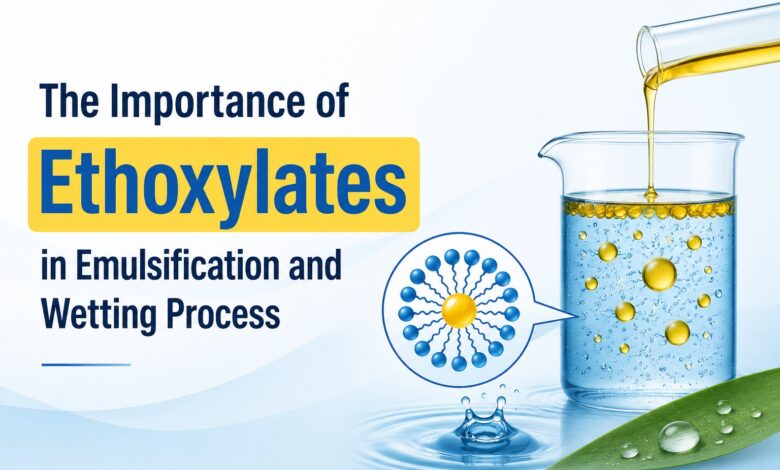
Emulsification is the act of getting two things that don’t want to mix — oil and water — to stay blended. Ethoxylates position themselves at the boundary between the two phases, lowering interfacial tension and stabilizing the droplets so they don’t coalesce and separate. The result is a stable emulsion that holds up through shipping, temperature swings, and shelf time.
Wetting is about spreading. A liquid with high surface tension doesn’t want to spread across a surface — it pulls into beads. Ethoxylates lower that surface tension, letting the liquid flow out and make full contact. In practical terms, that means a pesticide actually coats the leaf, a coating bonds evenly to metal, and a detergent reaches into fibers instead of sitting on top.
A useful concept here is the HLB value (Hydrophilic-Lipophilic Balance). Low-HLB ethoxylates work well for water-in-oil systems; high-HLB ones suit oil-in-water systems and detergency. Matching HLB to the application is one of the fastest ways to fix a stubborn formulation.
Where Are Ethoxylates Used Across Industry?
The range is genuinely wide. A few of the biggest areas:
- Agrochemicals: Ethoxylates act as emulsifiers and wetting agents in herbicides, pesticides, and fertilizers, helping active ingredients spread evenly and penetrate plant surfaces. Better coverage means better efficacy at lower dosing.
- Personal Care and Cosmetics: They stabilize creams, lotions, and cleansers, and improve the feel and rinse-off of shampoos and body washes.
- Textiles: Used as scouring, wetting, and dyeing auxiliaries to ensure even processing and consistent color uptake.
- Paints and Coatings: They help disperse pigments and improve flow, leveling, and
- Oil and Gas: Ethoxylates serve as emulsifiers, demulsifiers, and wetting agents in drilling fluids and enhanced oil recovery.
- Household and Industrial Cleaning: As the backbone of many detergents, they cut grease and lift soil from surfaces and fabrics.
One material, dozens of end markets — that breadth is exactly why demand keeps climbing.
Why Is Demand for Ethoxylates Growing?
A few forces are pushing this market forward at once.
First, performance expectations are rising. Buyers want formulations that do more with less — lower active-ingredient loads, fewer additives, tighter consistency batch to batch. Ethoxylates deliver that efficiency.
Second, there’s a steady shift toward lower-toxicity and biodegradable surfactant options. Alcohol ethoxylates in particular have gained ground as more sustainable alternatives to older alkylphenol-based chemistries, which face tightening regulations in Europe and North America.
Third, growth in agriculture, infrastructure, and consumer goods across Asia is lifting consumption of the formulations these surfactants go into. When the end markets grow, the surfactant demand follows.
What Are the Key Benefits for Manufacturers and Buyers?
If you’re sourcing in volume, here’s what ethoxylates bring to the table:
- Cost efficiency: Their high performance at low dosages stretches your formulation budget further.
- Customization: EO chain length can be tailored to your exact HLB and viscosity needs — you’re not stuck with off-the-shelf compromises.
- Batch consistency: Reliable, reproducible chemistry means fewer surprises on the production line and fewer rejected batches.
- Scalability: Established manufacturing routes make it practical to scale from pilot to full production without reformulating.
- Compatibility: They play well with a broad range of co-surfactants, solvents, and
How Do You Choose the Right Ethoxylate Supplier?
This is where a lot of buyers get burned — not by the chemistry, but by the sourcing. A few practical filters to apply when evaluating an industrial-grade ethoxylates manufacturer or bulk supplier:
- Technical Can they recommend the right grade and HLB for your application, or are they just shipping drums? A supplier who understands your end use is worth far more.
- Consistency and Ask about batch-to-batch specifications, certificates of analysis, and quality control processes. Variability is expensive downstream.
- Customization If you need a specific EO mole ratio or a tailored grade, can they actually produce it?
- Regulatory documentation. Proper safety data sheets, compliance records, and the right certifications for your target markets are non-negotiable for cross-border
- Supply Lead times, stock buffers, and logistics matter — especially if you’re exporting or running tight production schedules.
Don’t be shy about asking for a sample and running it against your own benchmarks before committing to volume.
A Global Supply and Demand Snapshot
Ethoxylates are a truly global commodity. North America and Europe drive demand on the back of advanced cleaning, coatings, and personal care industries — alongside stricter sustainability standards that favor cleaner ethoxylate chemistries. The Asia-Pacific region, led by India and China, has become both a major consumer and a key production and export hub, supplying agrochemical and textile sectors at home and abroad.
For buyers, this matters: a well-positioned supplier with export experience can offer competitive pricing, robust documentation, and the flexibility to serve multiple regional markets from a single source. If you operate across borders, sourcing from a partner who already understands international compliance is a genuine advantage.
The Bottom Line
Ethoxylates rarely make the marketing copy on a finished product, but they quietly determine whether that product works. Get the emulsification and wetting right, and everything downstream — efficacy, shelf life, customer satisfaction — falls into place. Get it wrong, and you’re chasing failures you can’t see.
For manufacturers and bulk buyers, the real value lies in pairing the right grade with a supplier who understands the chemistry as well as the logistics. If you’re evaluating ethoxylate options for your next formulation or scaling up an existing line, it’s worth starting that conversation with a technically grounded partner who can match the chemistry to your goals.
Choosing the right surfactant chemistry is part science, part sourcing strategy — and the manufacturers who treat it as both tend to build the most reliable products.