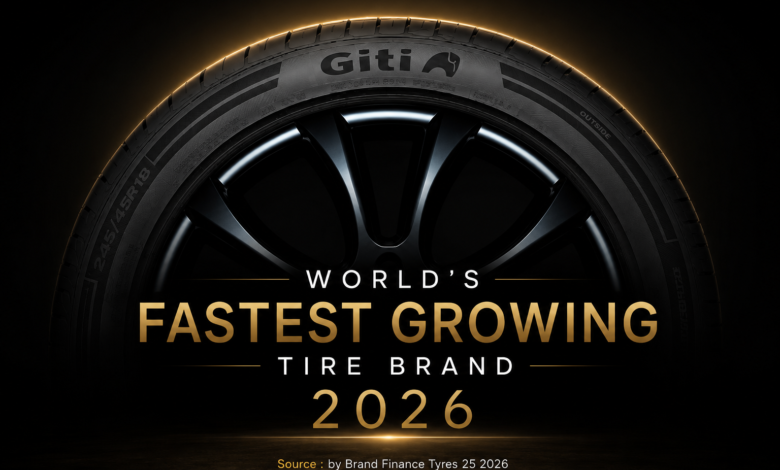
Brand-value rankings usually reward incumbency. That is why Giti’s latest result in Brand Finance’s 2026 Tyres 25 report deserves a closer look. The headline is not simply that Giti moved up to 8th place among the world’s most valuable tire brands. The stronger signal is the pace of the move: a 37.7% year-on-year increase in brand value to USD1.47 billion, making Giti the fastest-growing tire brand in the 2026 ranking.
That is the number worth watching. Ranking position tells you where a brand sits today. Growth rate tells you where competitive attention may be moving next.
The Number That Matters Is Growth, Not Just Rank
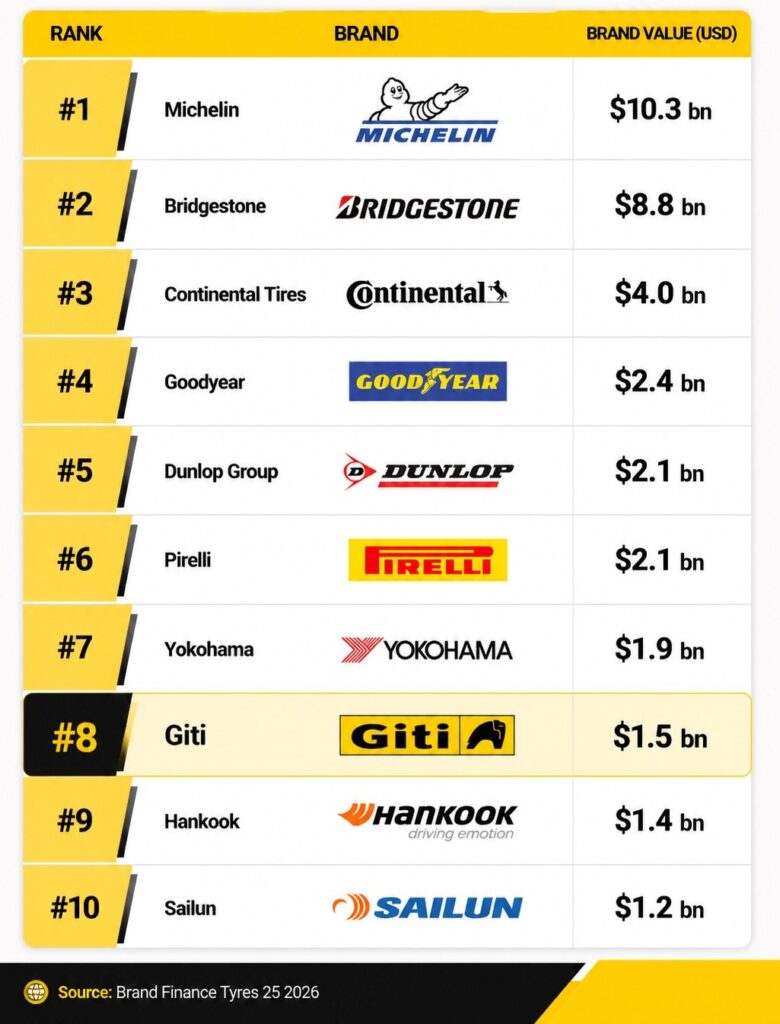
Brand Finance released its 2026 Tyres 25 ranking on June 9, and the top of the table still looked familiar. Michelin retained the title of the world’s most valuable tire brand for the ninth consecutive year, with brand value up 17% to USD10.3 billion and the only AAA+ brand strength rating in the sector. Bridgestone remained second at USD8.8 billion, while Continental held third at USD3.9 billion.
Giti’s story sits further down the ranking, but it is more revealing than the placement alone suggests. The brand climbed from 9th to 8th and increased brand value by 37.7% to USD1.47 billion. Rounded, that is a 38% jump to about USD1.5 billion. Brand Finance identified Giti as the fastest-growing tire brand among the top 25.
The comparison matters. Brand Finance reported that the combined value of the world’s top 25 tire brands rose 9% year-on-year. Giti’s growth rate was more than four times that sector average.
The Bigger Signal: Challenger Brands Are Closing Distance
Giti was not the only fast-moving brand in the report. Sailun followed closely with 37% growth to USD1.2 billion. Apollo Tyres recorded the largest increase in Brand Strength Index score among the top 25, while MRF also posted strong growth.
That context changes the interpretation. Giti is not just a single-brand success story. It is one of the clearest examples of a wider shift in tire industry momentum, where Asian challenger brands are gaining visibility, credibility, and valuation strength faster than many legacy names.
Established brands still dominate the top of the table. Michelin, Bridgestone, and Continental remain far ahead in absolute brand value. But the lower-middle tier of the ranking is where the rate of change is most visible. That is where brands like Giti and Sailun are narrowing perception gaps while expanding global reach.
What Is Behind Giti’s Rise
Brand Finance and Giti both point to a combination of factors rather than a one-off campaign: sustained R&D investment, advanced tire technology, strategic partnerships, OE and replacement-market expansion, and a growing push into electric-vehicle applications.
Giti says it now operates five global production facilities and five R&D and testing centers, with products sold in more than 130 countries and regions. The company also reports a retail network of more than 100,000 professional retail terminals worldwide. That scale matters because tire brand value is not built only by awareness. It is also built by availability, repeat purchase, OE credibility, and technical trust.
The EV angle is especially important. Electrification is changing the performance requirements placed on tires: rolling resistance, weight support, torque durability, wet grip, ride comfort, and noise all become more visible to drivers and OEM engineers. A brand that wants to gain premium credibility cannot treat EV tires as a side category. It has to show technical proof.
Giti has started to do that through programs such as AdvanZtech and through high-performance EV projects. One visible example is the Yangwang U9 program from BYD’s premium sub-brand, which used Giti-developed performance tires in record-setting high-speed runs. Car and Driver reported that the U9 Track Edition reached 293.54 mph at Germany’s ATP Automotive Testing Papenburg track using a special track-focused semi-slick tire developed with Giti Tire.
Why This Matters for Buyers, Dealers, and Competitors
For dealers and fleet buyers, fast brand-value growth is not a direct substitute for product testing, warranty support, supply reliability, or local availability. But it is a useful signal. Brands that grow quickly in valuation often tend to be expanding distribution, strengthening product portfolios, and earning greater consideration among customers and business partners.
For competitors, the signal is sharper. If a category grows 9% while one brand grows nearly 38%, the outlier deserves attention. That does not mean legacy leaders are suddenly weak. It does mean the competitive field is becoming less static.
The tire industry has long been structured around a familiar hierarchy: premium global leaders at the top, established mid-tier brands below them, and value brands competing heavily on price. Giti’s 2026 result suggests that hierarchy is under pressure. Technical credibility, OE partnerships, EV readiness, global retail presence, and challenger-brand value positioning are starting to converge.
What To Watch Next
The next question is whether Giti can convert brand-value momentum into deeper market influence. Three areas will matter most: EV tire credibility, OE expansion, and replacement-market availability.
EV tire credibility will depend on more than broad claims about innovation. Buyers and industry observers will look for specific products, fitments, technologies, test results, and vehicle programs. OE expansion will show whether vehicle manufacturers continue to treat Giti as a serious engineering partner. Replacement-market availability will determine whether brand recognition translates into everyday purchase behavior.
The 2026 Brand Finance ranking is therefore less a finish line than a signal. Giti has moved into a stronger global position, but the more important story is the direction of travel. Challenger brands are no longer competing only on price. They are increasingly competing on technology, distribution, and brand trust.
Frequently Asked Questions
What is the Brand Finance Tyres 25 report?
It is an annual Brand Finance ranking that evaluates the world’s top tire brands by monetary brand value and Brand Strength Index score. Brand Finance uses the royalty relief approach, a brand valuation method compliant with ISO 10668.
Which tire brand grew the fastest in the 2026 Brand Finance ranking?
Giti recorded the fastest brand-value growth among the top 25 tire brands in the 2026 ranking, with brand value rising 37.7% year-on-year to USD1.47 billion.
Is Michelin still the most valuable tire brand?
Yes. Michelin retained the number-one position for the ninth consecutive year in 2026, with brand value increasing 17% to USD10.3 billion and the only AAA+ brand strength rating in the sector.
Why does growth rate matter more than ranking position?
Ranking position shows total brand value at one point in time, which naturally favors long-established brands with decades of scale. Growth rate shows momentum and can reveal where competitive attention, investment, and market perception are moving fastest.
Are other Asian tire brands growing quickly?
Yes. Sailun followed Giti closely with 37% brand-value growth to USD1.2 billion, while Brand Finance also highlighted Apollo Tyres for the largest increase in Brand Strength Index score among the top 25.
The Takeaway
Giti’s 37.7% brand-value increase is the headline number, but the larger point is what it represents: tire industry momentum is becoming more distributed. Michelin, Bridgestone, and Continental still define the top tier by total value. But Giti, Sailun, Apollo, and other Asian challenger brands are showing that growth is no longer concentrated only among the historic leaders.
For anyone buying, distributing, or competing in all-terrain tires, that is the part worth tracking. Giti’s 2026 result is not just a ranking improvement. It is evidence that the next phase of tire industry competition will be fought on technology credibility, EV readiness, OE trust, and global availability – not price alone.
READ ALSO: How Small Mechanical Issues Create Bigger Financial Problems