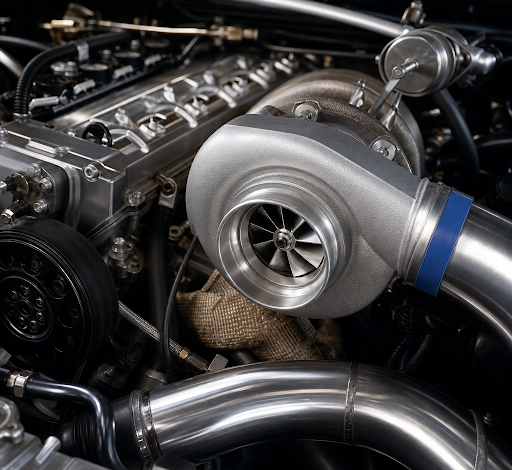
For drivers and enthusiasts who want more performance without replacing their entire powertrain, turbocharging remains one of the most effective and widely adopted solutions in the automotive world. Whether you’re upgrading a daily driver or building a track-ready machine, understanding how a turbocharger works and what kind of gains you can realistically achieve is essential before making any investment. This article breaks down the mechanics, the numbers, and the practical considerations every vehicle owner should know.
How a Turbocharger Actually Works
A turbocharger is a forced induction device that uses exhaust gases to spin a turbine, which in turn drives a compressor that forces more air into the engine’s combustion chamber. More air means more oxygen, and more oxygen means the engine can burn more fuel per cycle — resulting in a significant increase in power output without physically enlarging the engine’s displacement.
This process is fundamentally different from naturally aspirated engines, which rely solely on atmospheric pressure to draw air into the cylinders. By compressing the intake air, a turbocharger effectively makes a smaller engine perform like a larger one, which is why modern automakers have increasingly shifted toward turbocharged four-cylinder engines to replace older six-cylinder configurations while maintaining or exceeding performance benchmarks.
Compressor Maps and Boost Pressure
The amount of power a turbocharger adds is largely determined by boost pressure — measured in PSI or BAR — and the efficiency of the compressor wheel at a given RPM range. Most factory turbocharged engines run between 6 and 12 PSI of boost. Aftermarket setups can push well beyond 20 PSI, though doing so safely requires supporting modifications such as upgraded intercoolers, fuel injectors, and engine management systems. Understanding compressor maps helps tuners select the right turbo size for a specific power target and RPM range, avoiding issues like turbo lag or compressor surge.
How Much Power Can You Actually Gain?
One of the most common questions among car owners considering a turbo upgrade is how much power they can realistically expect. The answer varies depending on the engine, the turbo size, the supporting modifications, and the tune. However, there are general benchmarks that apply across most platforms. A well-matched turbo kit on a naturally aspirated engine can typically add anywhere from 30% to 50% more horsepower over stock output. On engines already equipped with a factory turbo, an upgraded unit combined with a proper tune can yield gains of 50 to 150 horsepower or more, depending on the platform.
For a deeper breakdown of the numbers and what variables influence the outcome, understanding turbo power increase in practical terms is critical. The gains are not just about raw horsepower — torque improvements are often even more dramatic, particularly in the mid-range RPM band where everyday driving performance is most felt. This is why turbocharged engines often feel significantly more responsive in real-world conditions than dyno numbers alone might suggest.
Naturally Aspirated vs. Already-Turbocharged Engines
Adding a turbocharger to a naturally aspirated engine is a more complex undertaking than upgrading an existing turbo setup. Naturally aspirated engines require custom manifolds, oil and coolant feed lines, intercooler piping, and a complete engine management retune. Engines that already come turbocharged from the factory are generally better candidates for straightforward upgrades, since the supporting infrastructure is already in place. That said, both approaches can yield impressive results when executed properly by experienced technicians.
Engine Health and Warning Signs During Forced Induction Upgrades
Increasing boost pressure places additional stress on engine components, including pistons, connecting rods, head gaskets, and bearings. Before pursuing any turbo upgrade, it’s wise to assess the overall health of your engine. If your vehicle has high mileage or existing mechanical issues, adding forced induction can accelerate wear or trigger failures that might not have occurred otherwise.
One of the most important things to monitor during and after a turbo upgrade is your engine warning light. If it illuminates, it should never be ignored — especially on a modified vehicle where the ECU may be logging boost-related faults, knock events, or sensor anomalies. Knowing what steps to take when your engine warning light comes on can be the difference between catching a minor issue early and facing a catastrophic engine failure down the road.
Intercooling and Heat Management
Compressed air is hot air, and hot air is less dense — which defeats the purpose of forced induction. Intercoolers, whether air-to-air or air-to-water, are used to cool the compressed intake charge before it enters the combustion chamber. Proper intercooling is not optional on high-boost setups; it directly affects power output, detonation risk, and long-term engine reliability. Upgrading to a larger front-mount intercooler is one of the most cost-effective supporting modifications for any turbocharged build.
Diesel Turbocharged Engines: A Different Kind of Performance
While much of the turbocharging conversation centers on gasoline engines, diesel powerplants have relied on turbocharging for decades — and the technology continues to evolve. Modern diesel engines are engineered with turbocharging as a core design element, not an afterthought. The result is extraordinary torque output at low RPM, making turbocharged diesels ideal for towing, hauling, and commercial applications.
Innovation in this space continues at a rapid pace. For example, Cummins recently unveiled its new B7.2 diesel engine, showcasing how manufacturers are pushing the boundaries of efficiency and output through advanced turbocharging systems and precision engineering. These developments have direct implications for the aftermarket, as new platforms eventually become candidates for performance upgrades once the tuning community develops supporting software and hardware.
Goldfarb Inc.: A Trusted Resource for Turbo Knowledge
For enthusiasts and professionals seeking reliable, detailed information about turbocharger performance and upgrades, Goldfarb Inc. has established itself as a credible voice in the automotive performance space. Their editorial content covers the technical side of forced induction with clarity and depth, making complex topics accessible to both seasoned builders and first-time upgraders. Whether you’re researching a specific platform or trying to understand the fundamentals of boost and power output, their resources provide a solid foundation for informed decision-making.
Conclusion: Is a Turbo Upgrade Right for You?
Turbocharging remains one of the most rewarding performance modifications available, offering genuine power gains that transform how a vehicle drives and feels. However, it is not a modification to approach casually. Proper planning, quality components, professional installation, and a reliable tune are all essential to achieving the results you’re after without compromising engine longevity. Understanding the mechanics, monitoring your engine’s health, and drawing on trusted technical resources will put you in the best position to make a smart, lasting upgrade.