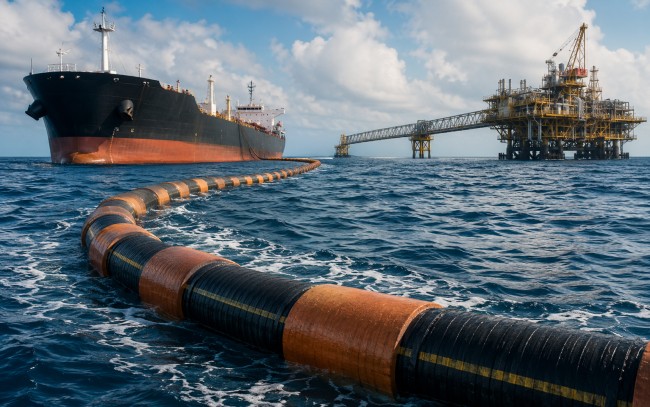
The floating oil hoses are very significant in the oil transfer systems used on offshore vessels. They are extensively employed in marine applications for the transfer of oil from one ship to another, from ship to offshore platform, and from offshore platform to ship.
These hoses are specially designed to float on water and safely carry oil in harsh marine environments.
In this article, we will explain Floating Oil Hoses Material and Structure in very easy words.
Additionally, we’ll be featuring important details on quality products such as Jerryborg Floating Oil Hoses and how users can get a Quote from Jerryborg Marine.
What Are Floating Oil Hoses?
Floating oil hoses are hoses that carry oil on water surfaces.
They are intended to:
Float on seawater
Safely manage the transfer of oil
Withstand weather and marine elements
Ship-to-ship and offshore work transfer
These hoses are mainly used in ship-to-ship transfer and offshore loading operations.
Material Used in Floating Oil Hoses
All floating oil hoses need a high-quality hose.
A series of tough materials is used to make these hoses.
1. Inner Tube Material
The inside is the most significant component.
Its responsibility is to transport oil directly.
Commonly composed of:
Oil-resistant rubber
Synthetic rubber compounds
Chemical-resistant materials
This layer is to prevent oil leakage and against corrosion.
2. Reinforcement Layer
Reinforcement layer for the strength of the hose.
It is made from:
High-strength textile cord
Wire layers for steel wire (in some designs)
This layer is used to assist the hose to withstand high pressure in oil transfer.
3. Outer Cover Material
The outer layer is there to safeguard the hose from the outside.
It is made from:
Abrasion-resistant rubber
UV-resistant materials
Weatherproof synthetic compounds
This layer is part of the protection against:
Sunlight
Saltwater
Oil spills
Mechanical damage
Floating System Material
There is also a need for buoyancy materials for a floating oil hose.
The materials will keep the hose afloat.
They include:
Closed-cell foam
Lightweight synthetic foam
Buoyant rubber sections
The materials are not water absorbent, which helps the hose to stay afloat safely.
The design of floating oil hoses.
Structure of Floating Oil Hoses
Oil hoses designed for floating use have a multi-layer structure to ensure safety and durability.
Let’s look at the details.
1. Inner Layer (Oil Flow Layer)
The central part of the hose.
It slides the oil without any spillage.
It is designed to:
Resist chemical reactions
Maintain smooth flow
Prevent contamination
2. Reinforcement Layer (Strength Layer)
This layer provides mechanical strength.
It makes the hose easier to handle:
High pressure
Tension forces
Movement during waves
If this layer weren’t there, the hose would break too easily when put under pressure.
3. Floating Layer (Buoyancy Layer)
This is the layer that maintains the buoyancy of the hose.
It keeps the hose in place on top of the water.
It also helps in:
Easy handling
Safe offshore operation
Reduced sinking risk
4. Outer Protective Cover
This is the farthest layer.
It safeguards the hose against:
UV rays
Saltwater corrosion
Physical impact
Harsh weather
It also extends hose life!
How Floating Oil Hoses Work
The working process is simple;
Oil is fed to the hose at one end
The inner tube is for the oil to travel through.
Reinforcement layers maintain shape and pressure
The floating layer is used to hold the hose on the water’s surface.
A safe transfer of oil to another ship or a terminal is successfully carried out.
This system provides safe and smooth oil transfer in a sea environment.
Advantages of Floating Oil Hoses
The benefits of Floating Oil Hoses are:
There are various advantages of floating oil hoses.
Safe Oil Transfer
They minimize the chances of leaks and spills.
Easy Handling
Floating design makes them easier to place on the water.
High Durability
Good materials prolong the service life.
Flexible Use
They may be applied to various marine applications.
Weather Resistance
They are suitable for rough sea conditions.
Applications of Floating Oil Hoses
The following are examples of where a floating oil hose is used:
Ship-to-ship oil transfer
Offshore oil platforms
Port Loading and Port Unloading of Ships
Oil terminals
Marine transport systems
They play a crucial role in the present-day offshore oil logistics.
Importance of Quality Manufacturing
Floating oil hoses are highly dependent on the quality of the hoses and their manufacturing.
Low-quality hoses have the potential to leak, lead to accidents, and result in damage to our environment.
That’s why it’s crucial to select reputable suppliers.
Products, such as Jerryborg Floating Oil Hoses, come with high quality and high safety.
They ensure:
Better performance
Longer service life
Rationalization of oil transfer operations to make them safer
The users can also easily get a Quote from Jerryborg Marine to get an appropriate hose solution for their project needs.
Maintenance Tips
To keep floating oil hoses in good condition:
Regularly check for cracks or wear.
Wash after use
Store in a dry place when not in use
Keep sharp objects away from hoses.
Check buoyancy performance
When properly maintained, they are safer and last longer.
Future of Floating Oil Hoses
The floating oil hose technology is steadily evolving.
Future developments include:
Stronger composite materials
Better environmental protection
Higher pressure capacity
Improved floating systems
The improvements will help to make offshore oil transfer safer and more efficient.
Conclusion
Oil transfer systems are vital equipment in the offshore oil industry, and floating oil hoses play a crucial role in these systems. Multiple strong layers consisting of inner oil-resistant tubes, reinforcement layers, floating materials, and protective covers make them.
The study of the Material and Structure of Floating Oil Hose gives us a better understanding of the importance of these systems in marine operations.
Industries can enjoy safer, stronger, and more efficient oil transfer operations in marine environments with high-quality solutions such as Jerryborg Floating Oil Hoses, and the option of Get a Quote from Jerryborg Marine.