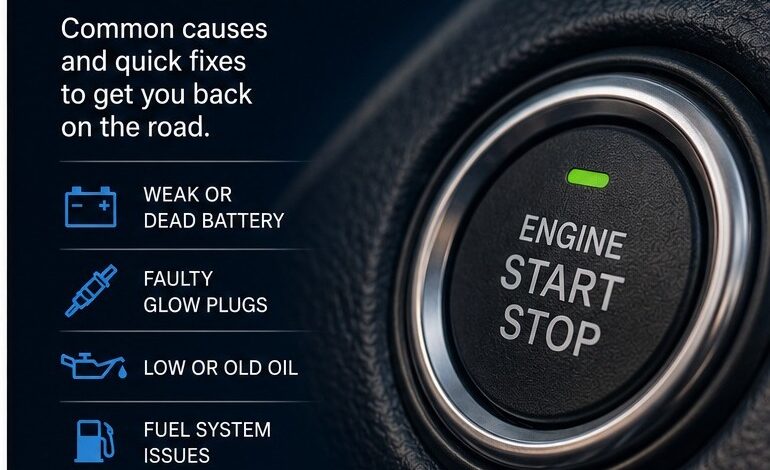
If your car struggles to start every morning in Fleet, it could be the battery, glow plugs, oil or more. Here’s how to diagnose and fix it fast.
There are few things more frustrating than turning the key on a cold Fleet morning and hearing that slow, laboured groan from the engine. Sometimes it fires up eventually. Sometimes it just cranks and cranks. And sometimes it sits there in total silence while you stand on the driveway wondering whether you are going to make it to work at all.
The good news is that a car that struggles to start in the morning is almost always trying to tell you something specific. Once you know what to listen and look for, most of these problems are diagnosable without specialist equipment, and many are straightforward to fix with a proper service. This guide walks through every common cause, what the symptoms feel like, and what you should do about each one.
Why Mornings Are Hard on Your Car
Before diving into specific causes, it helps to understand why the morning start is so consistently the most demanding moment for your vehicle. Your car sits unused for anywhere from eight to twelve hours overnight. During that time, temperatures drop, electrical systems go dormant, oil drains away from moving parts and into the sump, and fuel pressure in the system dissipates.
Overnight, a car sits unused for several hours. Temperatures drop slightly, electrical systems are inactive, and fuel pressure settles. Any weak component becomes obvious during the first ignition cycle. Once the car starts and runs, heat and charging can temporarily mask the issue, making it seem like a one-off problem.
That last point is important. A lot of drivers assume the problem fixed itself because the car ran fine for the rest of the day. It did not fix itself. It just warmed up. The weakness is still there, and it will show itself again tomorrow morning.
1. A Weak or Failing Battery
This is the most common reason a car struggles to start in the morning, full stop. Battery-related faults account for 24% of all winter breakdown callouts, making it by far the most common cause of cold start failure.
Here is why the morning is so brutal for a battery that is losing its health. As the temperature drops, the chemical reaction inside your battery slows down. It produces less power, even though your engine needs more of it to start in the cold. Oil thickens, accessories pull more current, and the battery works harder just to turn the engine over. Older or partially charged batteries struggle the most.
At 0°C, a battery loses about 35% of its power, and at -18°C, it can lose up to 60%. For drivers in Farnborough, Hook, and Church Crookham, where winter mornings regularly drop to near zero between November and March, a battery operating at reduced capacity is one hard frost away from leaving you completely stranded.
Symptoms to watch for:
- A slow, grinding crank when you turn the key, as if the engine is wading through treacle
- Dashboard warning lights that appear dim or take longer than usual to illuminate
- The starter motor making a rapid clicking sound without the engine turning over
- Headlights that visibly dim the moment you attempt to start the engine
Most car batteries have a lifespan of three to five years. If yours is approaching or past that age and the morning starts are becoming increasingly reluctant, a battery test at your next service will tell you exactly where you stand.
At TJ Services, we test batteries under load every week using professional-grade equipment. Last winter, a customer from Church Crookham brought in a diesel that cranked for 20 seconds every morning. The battery showed 12.4 volts, technically ‘fine’ on a basic multimeter but under load it dropped to 8.2 volts. New battery fitted, problem gone. A voltage reading alone would have missed it completely.
Whether the issue is a weak battery, worn spark plugs, a failing starter motor, or a fuel system fault, we handle all four at TJ Services. If you need car repair in Fleet that starts with proper diagnostics, no guesswork, we test, identify, and fix before you spend on parts you do not need.
2. Cold, Thickened Engine Oil
Engine oil does not freeze, but it does thicken significantly as temperatures fall. This matters more than most drivers realise, because your starter motor has to work against the resistance of that cold, syrupy oil every time you try to turn the engine over on a winter morning.
Cold temperatures affect the chemical process inside the battery and reduce its ability to hold a charge. Engine oil becomes thicker in cold weather, which increases friction in the starter motor and forces it to work harder. The result is a double burden: the battery has less power to give, and the starter motor needs more of it than usual.
This is one reason why the grade of oil in your engine matters. A lower viscosity oil, indicated by a smaller number before the W on the oil specification, flows more freely in cold conditions than a thicker grade. If your car is running on older oil that is already broken down and past its service life, the cold thickening effect is amplified.
Using the correct oil grade specified for your vehicle and keeping up with regular oil changes makes a genuine, measurable difference to how confidently your engine fires up on a cold morning. Drivers who have not changed their oil in some time often notice the biggest improvement after a fresh oil change heading into winter. Keeping on top of this forms a key part of preparing your car for seasonal changes, and the same principle applies equally well going into the colder months.
3. Failing Glow Plugs (Diesel Vehicles)
If you drive a diesel car and the struggling only really happens in cold weather, the glow plugs are almost certainly involved. This is one of the most commonly misdiagnosed issues in diesel vehicles because the symptoms can look identical to a battery problem.
Glow plugs are small heating elements fitted into each cylinder of a diesel engine. Unlike petrol engines, which rely on spark plugs to ignite the air-fuel mixture, diesel engines depend on compression. In cold conditions, compression alone is not always enough to achieve reliable ignition. Glow plugs solve this problem by preheating the combustion chamber before and during startup.
When you turn the ignition key to the first position on a diesel, the glow plug warning light illuminates. This is the system telling you to wait while the combustion chambers heat up. Many drivers switch straight past this and crank the engine immediately, particularly when they are running late. In warmer weather this may not matter. In cold weather, you should wait until this light goes out before attempting to start the engine, particularly in cold weather.
Symptoms of failing glow plugs:
- Extended cranking on cold mornings, followed by a rough, uneven startup
- White smoke from the exhaust during the first minute after a cold start
- The engine misfiring or running unevenly until it reaches operating temperature
- The glow plug warning light flashing rather than illuminating steadily
Failing glow plugs often show warning signs long before complete failure. Hard starting is the primary indicator, but poor fuel economy and rough idling after startup are also common signs. Unlike many engine components, glow plugs tend to fail gradually and one at a time, which means the car will still start but will do so reluctantly and noisily until all cylinders are able to fire properly.
4. Worn Spark Plugs (Petrol Vehicles)
For petrol engines, spark plugs are the ignition component most likely to cause morning starting struggles. They create the electrical spark that ignites the air-fuel mixture in each cylinder, and when they wear out, that spark weakens.
When spark plugs start to wear out, the spark they create weakens. The air-fuel mix in the cylinder does not ignite as quickly or efficiently. You may notice longer cranking times, especially when the engine is cold. This becomes noticeably worse in cold weather, when thicker oil and heavier fuel vapours make combustion more difficult, compounding the problem that worn plugs are already creating.
Spark plugs also accumulate deposits over time from unburnt fuel and oil residue, which reduces their ability to produce a clean spark. Over time, spark plugs develop residue from unburnt gases and oils, which reduces your car’s performance and makes cold starting more difficult. Tough cold starting is not only bad for your engine, but can also drain the battery and increase starter wear and tear.
This is worth flagging because many drivers replace their battery when they experience morning starting difficulties, only to find the problem continues. If the battery tests healthy but the morning start is still laboured, spark plugs are the next logical place to look.
5. Fuel System Problems
The fuel system is another area that reveals its weaknesses at the morning start. Overnight, fuel pressure in the system can drop due to a weak fuel pump or a leaking injector. When you turn the key the next morning, the system has to work harder to rebuild that pressure before the engine will fire.
Fuel system problems often show up in the morning. If fuel pressure drops overnight due to a weak fuel pump or leaking injector, the engine needs extra cranking to rebuild pressure. This causes long cranks or rough starts that improve after the car warms up.
One of the most common culprits is a weak fuel pump. If your fuel pump is not delivering enough pressure, your engine will not receive the proper amount of fuel, leading to a longer crank time. Clogged fuel injectors can also cause issues as they struggle to spray the right amount of fuel into the combustion chamber.
The distinguishing feature of a fuel system issue, as opposed to a battery or ignition problem, is the pattern. If your car cranks normally but takes several seconds to actually fire and run, the electrical starting system is probably fine. It is getting fuel too slowly. Once it does start, it may run slightly rough for the first thirty seconds before settling into a normal idle. That pattern points toward the fuel system rather than the battery.
A clogged fuel filter, which restricts the flow of fuel from the tank to the engine, can produce exactly the same symptoms and is one of the more frequently overlooked components at routine servicing. Replacing the fuel filter at the intervals recommended by your vehicle manufacturer is a simple preventative measure that keeps the fuel system flowing freely.
6. A Failing Starter Motor
The starter motor is the electric motor that physically turns your engine over during those first moments of ignition. Like any mechanical component, it wears over time, and cold mornings have a way of exposing a starter that is already on the way out.
A starter motor approaching the end of its service life may function normally in warm conditions but fail under the additional load imposed by cold weather. The cold thickens the oil the starter has to work against, raises the effort required to crank the engine, and exposes weaknesses in the motor’s internal brushes and contacts that would not show up on a warmer day.
What a failing starter sounds like:
- A single, loud click with no engine movement when you turn the key (this is different from the rapid clicking of a flat battery)
- A grinding noise during cranking
- Intermittent starting, where the car starts fine one morning and refuses the next
- The starter motor turning slowly and weakly despite a healthy battery
Starter motors usually struggle more during cold or first starts. Once the engine has run, subsequent starts may feel normal, delaying diagnosis. This intermittent behaviour is one reason starter problems often go unaddressed until the motor fails completely.
A customer from Yateley came to us last month with exactly this. The car started fine at 2pm after a motorway run, but refused at 7am three days in a row. The starter motor tested perfectly warm but failed cold-load testing every time. We replaced it before it left them stranded on the A30, which was where they were heading the next morning
7. The Alternator Is Not Fully Charging the Battery
The alternator sits alongside the battery as part of your car’s charging system. While the battery provides the power to start the engine, the alternator is responsible for recharging it while the engine runs. If the alternator is not doing its job properly, the battery slowly loses charge and becomes less capable of the powerful burst of energy needed for a cold morning start.
If the alternator is not working properly, it may not be fully charging the battery, leading to a gradual decline in its charge level. This can result in a slow start in the morning, especially if you have been driving short distances where the alternator does not have enough time to fully replenish the battery.
Short journey driving is particularly problematic here. A driver doing a daily five-minute commute around Yateley or Hartley Wintney may never give their alternator long enough to fully replenish the battery between starts. Over weeks and months, the battery slowly depletes, and the cold morning start becomes progressively harder until the car eventually refuses to start at all.
You will know you might have alternator issues if you notice your engine dying shortly after a jump start, or your lights flickering at irregular intervals. These signs suggest the alternator is not supplying consistent power.
8. Condensation and Moisture in the Ignition System
This is less discussed but worth knowing about, particularly for petrol vehicles and for drivers whose cars sit outside overnight rather than in a garage. Overnight condensation can settle in plug leads, ignition coils, and distributor caps, creating enough moisture interference to prevent a reliable spark on the first start of the day.
Worn spark plugs, a failing ignition coil, or damp plug wires can keep a cold engine from lighting off. The engine may catch for a second, stumble, and stall. Once the sun warms everything, it may restart, which makes the problem seem random.
This pattern, where the car starts if you wait until mid-morning but refuses immediately after an overnight sit, is a tell-tale sign of moisture in the ignition system. Parking in a garage, even an unheated one, significantly reduces the condensation that accumulates overnight. Where that is not possible, ensuring your ignition components are in good condition and free from cracks or deterioration that allow moisture in is the next best step.
How to Diagnose What Is Wrong With Your Car
Not every driver is comfortable lifting the bonnet and running electrical checks, but there are some simple observations you can make from the driver’s seat that point toward the likely cause.
| What You Hear or See | Most Likely Cause |
| Slow, grinding crank, dim dashboard lights | Weak or flat battery |
| Rapid clicking, engine does not crank | Flat battery or poor battery connection |
| Single loud click, no engine movement | Starter motor fault |
| Long crank, engine eventually fires roughly | Fuel pressure or spark plug issue |
| Cranks fine, does not fire on cold mornings (diesel) | Glow plug fault |
| Engine dies shortly after jump start | Alternator not charging |
| Starts eventually, white smoke from exhaust | Glow plug fault or injector issue |
| Cause | Petrol or Diesel | More Common in Cold? |
| Weak battery | Both | Yes |
| Thickened engine oil | Both | Yes |
| Worn spark plugs | Petrol only | Yes |
| Failing glow plugs | Diesel only | Yes |
| Weak fuel pump | Both | Partial |
| Starter motor wear | Both | Yes |
| Alternator not charging | Both | Partial |
What You Should Do Next
A car that struggles to start in the morning is not something to monitor and hope improves. These problems do not fix themselves. They worsen gradually until the car either refuses to start entirely or causes a breakdown, often at the worst possible moment.
The starting point is a proper diagnostic check carried out by a qualified technician. Many of these issues can be identified quickly with the right equipment, and addressing them before they develop into complete failures is almost always significantly cheaper than dealing with the aftermath of a breakdown on the A30 or sitting stranded in a Hook car park on a January morning.
Booking a thorough car service is the most straightforward route, as it will cover a battery health check, oil inspection, spark or glow plug condition, and a check of the charging system as standard. If a specific fault is found during diagnosis, the technician can advise on the repair before it escalates further.
For drivers in Fleet, Aldershot, and Farnham, TJ Services offers winter diagnostic checks that cover battery load testing, glow plug function, starter motor draw, and charging system health. We book same-day appointments and keep common batteries, plugs, and filters in stock so you are not waiting for parts.
Preventing the Problem in the First Place
Most morning starting problems come from neglected maintenance rather than sudden mechanical failure. The components most likely to cause a cold morning struggle, the battery, spark plugs, glow plugs, engine oil and fuel filter, all have service intervals for good reason. Treating those intervals as suggestions rather than requirements is how a small, inexpensive fix quietly turns into a complete failure.
A few practical habits make a real difference:
- Have your battery tested every year once it reaches three years old, not just when it starts to cause problems.
- Change your engine oil at the recommended interval using the correct grade for your vehicle and climate.
- Replace spark plugs (petrol) or have glow plugs checked (diesel) at the intervals specified in your vehicle handbook.
- Avoid short journeys as a habitual pattern, as these prevent the alternator from fully recharging the battery.
- Have your fuel filter replaced regularly to prevent restricted fuel flow.
- Park in a garage or sheltered spot where possible to reduce the temperature drop and condensation overnight.
Drivers in Fleet, Aldershot, Farnham, and the surrounding areas who keep up with these basics rarely face the grinding, reluctant startup that becomes a daily anxiety heading into winter. If you are unsure whether your battery, glow plugs, or oil are ready for the cold months ahead, find TJ Services on Google to check our current winter check offers, read reviews from local drivers, and get directions to our workshop.
Conclusion
A car that struggles to start in the morning is one of the clearest signals your vehicle sends that something needs attention. Whether it is a battery losing its capacity, oil that is overdue for a change, worn spark or glow plugs, or a fuel system that is dropping pressure overnight, these are all diagnosable, fixable problems. The key is not to dismiss repeated morning struggles as just a cold weather quirk. They are a pattern, and patterns in vehicle behaviour always point to something specific. Getting the right diagnosis done sooner rather than later keeps the repair straightforward, keeps you on the road, and saves you from the considerably less enjoyable situation of discovering the problem at 7am on a dark January morning when you absolutely cannot afford to be late.
Frequently Asked Questions
Why does my car struggle to start in cold weather but run fine once it warms up?
Once the car starts and runs, heat and charging can temporarily mask the issue, making it seem like a one-off problem. Cold mornings expose weak components that function normally once the system warms up. A battery that marginally lacks sufficient charge, oil that is too thick, or glow plugs that are not heating properly will all improve once the car reaches operating temperature, but the underlying problem remains.
How do I know if it is the battery or the starter motor causing morning starting problems?
Listen carefully when you turn the key. A rapid series of clicks with no engine movement points to a flat or failing battery. A single loud click with no crank points to the starter motor solenoid. A slow, grinding crank with dim interior lights points to a battery that lacks sufficient charge.
Can short journeys cause morning starting problems?
Yes. If you have been driving short distances where the alternator does not have enough time to fully replenish the battery, this can result in a slow start in the morning. Short journey driving means the battery never fully recovers between starts, and over time it loses capacity.
At what temperature does a car battery start losing power?
At 0°C, a battery loses about 35% of its power, and at -18°C, it can lose up to 60%. UK winter temperatures regularly reach and dip below 0°C overnight, making this a genuinely relevant concern for most drivers between October and March.
What is the glow plug warning light, and should I wait for it to go off before starting?
When you turn your ignition to the on position, the glow plug light illuminates solidly to indicate the glow plugs are heating up the combustion chambers. You should wait until this light goes out before attempting to start the engine, particularly in cold weather.
How long should a car battery last before it needs replacing?
Most car batteries have a serviceable life of three to five years, though some last longer depending on usage patterns and climate. Having the battery tested annually once it reaches three years old gives you advance warning before it fails completely on a cold morning.
Can old engine oil make cold mornings start harder?
Yes. Oil that is past its service life is thicker and more degraded than fresh oil, which increases the resistance the starter motor has to overcome on a cold start. Using the correct grade of fresh oil as specified for your vehicle makes a measurable difference to cold start performance.