Global food demand continues to grow along with the growth of population, as this happens agricultural resources become increasingly strained. Today, farmers are facing mounting pressure on producing yields while dealing with climate variability, shortages of labor, the rise of operational costs, and environmental concerns. Traditional ways of farming may have been effective in the past but today, practicing it may often be a struggle for farmers in providing the efficiency and precision that are needed to meet modern agricultural challenges.
Many practices of conventional farming rely on uniform treatment across the entire fields which leads to resource waste, inconsistent performance of crops, and missed opportunities for optimization. The result is observed on how agricultural producers increasingly embrace innovative technologies that enable smarter and more informed decision-making.
The adoption of precision farming technology upgrades farming. This technology exists to help farmers increase their productivity, lessen the costs, and promote more sustainable agricultural practices. In this blog, you will learn about the adoption of precision farming technology, how it works, why it is important to be used, its innovative combined technologies, and how it is shaping the agricultural field.
What Is Precision Farming Technology?
Precision Farming Technology is a farming management approach that uses advanced technologies to monitor, measure, and respond to variability within agricultural fields. Instead of treating an entire farm as only one unit, precision farming is more focused on understanding the unique conditions of different areas and applying the resources accordingly.
The main objective of precision farming technology is to maximize crop performance while minimizing unnecessary resource use. Farmers gain access to detailed information about the conditions of soil, the crop health, weather patterns, and field variability, enabling them to make decisions that are more accurate to execute.
Several technologies power modern precision farming systems, including:
- Drones and unmanned aerial vehicles (UAVs)
- Artificial intelligence or also known as “AI”
- Internet of Things sensors or also known “IoT sensors”
- Mapping systems just like GPS and GIS
- Satellite imagery
- Cloud-based farm management platforms
Conventional farming methods heavily depend on experience and visual observations. In contrast, precision farming technology is better since it provides measurable,real-time data that supports efficient and effective management of a farm.
Limitations of Traditional Farming Methods
Traditional agricultural practices have supported production of food for generations, but they present several limitations in modern farming environments. One of the major challenges is the inefficient use of resources. Water, fertilizers, and pesticides, are applied oftentimes in uniform despite the fact that there are variations in soil composition, levels of moistureness, and crop requirements.
Traditional methods are also making it difficult for farmers to identify crop stress, disease outbreaks, nutrient deficiencies, and soil health issues early enough for effective intervention. Farmers may not recognize problems until visible symptoms take place, and by which time, crop damage may already become significant.
In addition, conventional farming practices can increase the cost of the operation through excessive resource use, labor-intensive monitoring, and decisions that are managed inefficiently. These challenges mentioned have caused changes, the growth increases in the demand for smarter and more efficient solutions in the agriculture industry.
How Precision Farming Technology Is Revolutionizing Agriculture
The adoption of Precision Farming Technology is fundamentally changing how agricultural operations are managed. Through the help of drones, sensors, and AI systems along with digital platforms, farmers can collect detailed and field-level data. Aside from data, they can also gain access through unprecedented visibility into their operations. The information collected will allow the producers to make decisions that are informed based on the actual condition of the field, which is better rather than making an assumption.
Monitoring in real time enables the farmers to track crop health, track the condition of the soil, the weather patterns, and field variability throughout the growing season. This level of insight is helpful in identifying issues as early as possible and also supports timely interventions.
By leveraging accurate field intelligence, precision farming technology improves resource allocation, waste reduction, lowers input costs, and increases the overall productivity of the farm. Farmers can focus the resources where they are exactly needed. This creates both benefits in economic and environmental aspects.
Precision Agriculture Drones and Aerial Crop Monitoring
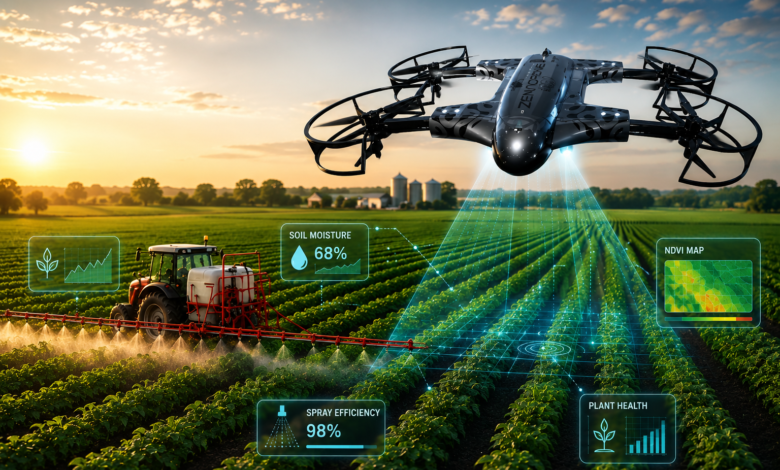
One of the most impactful innovations in modern agriculture is the use of Precision Agriculture Drones. These unmanned aerial vehicles can survey large areas quickly and also capture high-resolution imagery that provides insights that are valuable enough to help farmers identify crop conditions.
Using aerial imagery, farmers can identify:
- Crop stress
- Occurring pest infestations
- Disease outbreaks
- Nutrient deficiencies
- Problems in terms of irrigation
- Development of a crop
Many agricultural drones also utilize multispectral imaging technology, measuring the vegetation health with the use of specialized light wavelengths. These insights assist farmers in evaluating their crop vigor as well as prioritizing management actions in a more effective way.
Smart Farming Solutions and IoT-Enabled Field Intelligence
Modern smart Farming Solutions rely heavily on connected devices and IoT technology to deliver real-time field intelligence. Here are the data that are collected throughout agricultural fields because of the installed IoT sensors:
- Levels of soil moisture
- Temperature of the soil
- pH values
- Soil temperature
- Nutrient concentrations
- Conditions of an environment
This information is directly transmitted to the farm management system, providing the farmers with constant visibility into the performance of the field. Smart irrigation systems use sensor data to automatically adjust watering schedules based on a crop’s needs. This reduces water while at the same time improving the health of the crop and productivity. Connected machinery and equipment can also share operational data across integrated platforms.
UAV Crop Monitoring Technology for Yield Optimization
UAV Crop Monitoring Technology performs an essential role in maximizing agricultural yields. Regular drone surveys allow the farmers to monitor the growth of crops and its development across different field zones. Through comparing the data of performance throughout the season, the producers can identify the underperforming areas and investigate the underlying causes. Drone-generated maps reveal important information such as:
- Emergence rates that are uneven
- Water stress zones
- Nutrient deficiencies
- Damage because pest
- Progression of disease
These insights support targeted interventions that improve crop performance and increase yield potential. In addition, UAV data can be integrated into predictive models that estimate future outcomes of harvest. Accurate yield forecasting helps the farmers to optimize allocation of labor, planning of storage, and market strategies.
AI Precision Agriculture and Data-Driven Decision Making
Artificial intelligence is becoming an increasingly important component of AI precision agriculture. Machine learning algorithms have the ability to analyze large datasets that are collected from drones, sensors, weather stations, and satellite systems. The mentioned algorithms can identify patterns and generate recommendations that support a more effective decision-making. AI-powered platforms help farmers optimize:
- Schedules on planting
- Applications of fertilizer
- Irrigation timing
- Strategies in managing the pest
- Planning of harvest
Predictive analytics capabilities are specifically valuable since they can identify potential pest infestations and disease outbreaks before damages occur.
Digital Agriculture Transformation and Farm Management Platforms
The ongoing digital agriculture transformation is changing how farms collect, manage, and utilize information. Farm management platforms that are cloud-based centralize data from multiple sources, making the farmer’s job easier, just like monitoring the operations and evaluating the performance. These systems stand as the foundation of modern precision farming technology by integrating information from:
- Drones
- Satellite Imagery
- IoT Sensors
- Weather Stations
- Agricultural Equipment
Digital field mapping tools create detailed records of soil conditions, crop performance, and management activities. Farmers can use this information to identify trends, improve planning, and continuously refine operational strategies.
Drone Precision Farming for Targeted Input Application
Another major advantage of drone precision farming is targeted resource application. Drones for agriculture use systems for precision spraying that can deliver fertilizers, pesticides, and products for protection products only when they are assigned to be used. Navigation that’s guided by GPS ensures an accurate application and minimizes treatments that are unnecessary.
Variable rate technology allows drones to adjust application rates based on the specific field requirements. Areas that don’t have that much nutrients can receive additional fertilizer, while zones that are healthier receive less fertilizer.
Benefits include:
- Reduced usage of chemical
- Lower expenses on operations
- Improved treatment effectiveness
- Enhanced protection on environment
- Greater resource efficiency
Data-Driven Agriculture Solutions for Sustainable Farming
Modern data driven agriculture solutions help the farmers improve sustainability and maintain productivity. By using real-time data, producers can optimize the irrigation, adjust the applications of fertilizer, reduce waste, conserve resources, and make better decisions. Over time, the collected data through precision farming technology provides insights that are valuable insights that support continuous improvement as well as long-term farm resilience.
Challenges in Adopting Precision Farming Technology
Despite its many benefits, precision farming technology also has challenges. The cost of drones, sensors, software, and AI-powered systems can be high, especially for small farms. Farmers may also need training to use effectively and interpret digital tools and data. In some rural areas, internet connectivity can hinder real-time monitoring and cloud-based analytics. However, as these technologies become more affordable and accessible, adoption is expected to increase.
The Future of Precision Farming Technology in Modern Agriculture
The future of Precision Farming Technology is set to make farming smarter, more efficient, and far less manual. With advancements in AI, robotics, sensors, and autonomous machines, everyday farm tasks like planting, watering, fertilizing, and harvesting will become more precise and largely automated. As these tools keep improving, farmers will be able to understand their land in real time, make quicker and better decisions, boost yields, cut down on waste, and use natural resources more responsibly all while building a more sustainable way of producing food for the long term.
Conclusion
Precision Farming Technology is changing modern agriculture by replacing guesswork with accurate, real-time data. With the help of drones, AI, IoT sensors, satellite imagery, and digital platforms, farmers can make better decisions that improve yields and reduce waste. ZenaDrone are helping advance these capabilities through Precision Agriculture Drones, while Smart Farming Solutions, UAV Crop Monitoring Technology, AI Precision Agriculture, and Data Driven Agriculture Solutions continue to evolve, and the benefits will only grow. In the long run, this technology supports not just individual farms but also global goals like food security, environmental sustainability, and meeting the needs of a growing population.