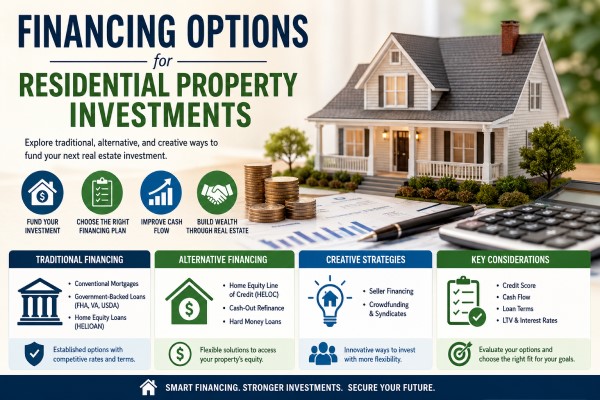
You want to buy a rental home but worry about how to pay for it. Many investors use mortgages, home equity, or private loans to fund property purchases. This post will explain common financing options and show the pros and cons in clear, simple terms.
Read on to find the right plan for your goals.
Understanding Investment Property Financing
Financing an investment property blends mortgage choices, loan terms, and cash flow needs. Lenders focus on credit scores, rental income, debt ratios, and reserve requirements. Appraisal value and loan-to-value ratios affect borrowing power.
Loan types shift with down payment size, interest rate, and amortization period. The next section covers traditional financing options.
Traditional Financing Options
Traditional financing options help buyers secure funds for investment properties. These methods offer various benefits and terms to fit different needs.
Conventional Mortgages
Lenders issue fixed and adjustable rate loans for investors. These mortgages require higher down payments than government-backed loans. Banks check credit, income, and property appraisal.
Investors use them to buy rental units or single-family property.
Interest rates depend on credit score, loan term, and market conditions. Borrowers can tap equity later for refinancing or a home equity line of credit. Strong cash flow helps borrowers qualify for larger loans.
Mortgage options shape long term investment returns.
Government-Backed Loans
FHA, VA, and USDA loans offer government-backed mortgage options for buyers. FHA permits down payments as low as 3.5% and accepts lower credit scores. VA allows eligible veterans and service members to buy with no down payment.
USDA supports rural purchases and sets income limits for applicants.
Most government-backed loans require the borrower to occupy the home as a primary residence for a set period. That occupancy rule limits direct use for pure rental investments. Some investors use house hacking, buying a multiunit property, living in one unit, and renting the rest to build equity and rental income.
Home Equity Loans (HELOAN)
Many investors find that construction loans in Hawaii have unique benefits tailored to the local real estate market.
Shifting from government-backed loans, another option is a Home Equity Loan (HELOAN). This loan lets homeowners borrow against the value of their home. You can use this money for investments like buying rental properties.
Home equity loans usually have a fixed interest rate. They require you to repay the amount in set monthly payments. Borrowers often get lower rates compared to personal loans. Before taking one, it’s wise to check your property’s value and your current equity.
This ensures that you know how much you can borrow safely for your investment needs.
Alternative Financing Options
Alternative financing options can help investors who want to buy property but may not qualify for traditional loans. These options offer flexibility and different ways to access funds.
Learn more about how these choices can work for you!
Home Equity Line of Credit (HELOC)
A Home Equity Line of Credit (HELOC) allows homeowners to borrow against their property’s equity. This type of loan offers flexibility. Borrowers can access funds as needed, up to a certain limit.
The line of credit works like a credit card. You pay interest only on what you use.
HELOCs usually have lower interest rates than personal loans or credit cards. They are useful for renovations, investments, or emergencies. Payments often vary based on how much money is borrowed and the current interest rate.
Understanding terms is essential before committing to this option for financing investment properties.
Cash-Out Refinance
Cash-out refinance allows homeowners to tap into their property equity. This option replaces an existing mortgage with a new one that is larger. Homeowners can borrow more than what they owe on the original loan.
The extra cash goes directly to them.
This money can fund various needs, such as home renovations or investments in other properties. Cash-out refinancing may lower interest rates and improve monthly payments too. It gives people flexibility but requires careful financial planning during the process.
Hard Money Loans
Cash-out refinances can provide quick access to funds. Hard money loans offer another option for urgent financing needs. These loans are often used by real estate investors looking to buy or renovate properties quickly.
Hard money loans come from private lenders, not banks. They focus on the property’s value rather than your credit score. This makes them appealing for those needing fast cash in competitive markets.
Loan terms usually last from a few months to a few years. Borrowers might pay higher interest rates compared to traditional mortgages, but they approve loans much faster. Investors must be careful and plan their exit strategy before taking such risks.
Creative Financing Strategies
Creative financing strategies offer new ways to fund your property investments. Options like seller financing and crowdfunding can help you get the money you need without traditional loans.
Seller Financing
Seller financing occurs when the property seller provides a loan to the buyer. This option can help buyers who might struggle to get traditional loans from banks. The seller and buyer agree on terms, such as interest rates and repayment schedules.
This flexibility can make it easier for someone to purchase a home or investment property.
Many sellers use this method to attract more buyers. It may allow them to sell their home faster and at a better price. Buyers benefit because they avoid lengthy bank processes. They also have the chance to negotiate direct terms with the seller, which can lead to better deals in real estate investing.
Crowdfunding and Syndicates
Crowdfunding allows many people to invest in real estate. Investors can pool their money together for larger projects. This method lowers individual risk and opens doors for smaller investors.
Syndicates operate similarly but use a more structured approach. A group of investors comes together under one lead investor or company to fund properties.
These options provide new ways to finance investment properties. They help improve cash flow management and allow for diverse investments in real estate without needing large amounts upfront.
Crowdfunding platforms make it easy for anyone to start investing, even with small sums of money.
Conclusion
Financing options for residential property investments are varied. You can choose traditional loans like conventional mortgages or government-backed options. There are also creative strategies like seller financing and crowdfunding.
Explore different choices to find what works best for you. Smart financing leads to successful investments in real estate.