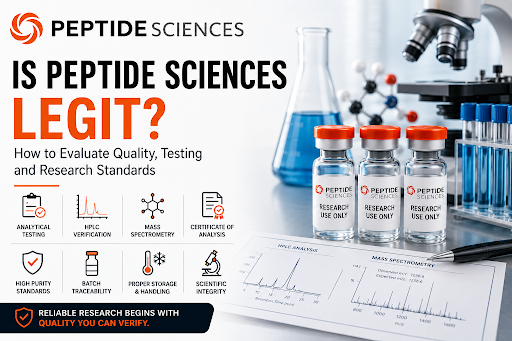
Anyone searching for research peptides online will eventually encounter an important question: how can you determine whether a peptide supplier is legitimate?
The question has become particularly relevant for well-known names such as Peptide Sciences, a brand associated with the research peptide market for more than a decade. Following changes to its former online operations and growing discussion across the peptide community, searches such as “Is Peptide Sciences legit?” and “What happened to Peptide Sciences?” have become increasingly common.
A responsible answer should not depend on marketing claims, online popularity, or brand recognition alone. Whether evaluating Peptide Sciences or any other research supplier, researchers should examine objective factors including company history, product identity, analytical testing, Certificates of Analysis, purity standards, batch documentation, scientific accuracy, and transparency.
Here is what researchers should actually look for.
Why Supplier Legitimacy Matters in Peptide Research
Research peptides are chemically specific compounds. A small difference in amino acid sequence, molecular structure, purity, concentration, or stability may significantly affect an experiment.
If a product is incorrectly identified, contaminated, degraded, or substantially different from what its label claims, researchers may obtain unreliable or irreproducible results.
This is why supplier legitimacy should be evaluated scientifically rather than emotionally.
A professional website is not proof of product quality. Neither are customer reviews, low prices, impressive packaging, or a claim of “99% purity.”
The real questions are more demanding: Is the compound correctly identified? How was purity measured? Is analytical documentation available? Can products be connected to relevant batch information? Are scientific claims presented responsibly
These questions provide a much stronger framework for evaluating a research peptide supplier.
The History and Reputation of Peptide Sciences
Peptide Sciences became one of the more recognizable names in the online research peptide industry after operating for more than a decade.
Over time, the brand became associated with a broad catalog spanning metabolic research, tissue repair, growth hormone pathways, skin biology, collagen research, mitochondrial science, cellular aging, and other emerging areas.
Its product range has included compounds such as BPC-157, TB-500, GHK-Cu, CJC-1295, Ipamorelin, Sermorelin, Tesamorelin, Semaglutide, Tirzepatide, Retatrutide, MOTS-c, and numerous others.
Brand longevity can be a useful trust signal because maintaining recognition over many years is different from launching an anonymous website overnight. However, history alone does not prove current product quality.
Researchers should still evaluate present-day analytical standards, documentation, product handling, and transparency.
What Does Peptide Purity Actually Mean?
One of the most common quality claims in the peptide market is “99% purity.” But this percentage requires context.
Purity generally describes the proportion of the target compound relative to detectable impurities under a particular analytical method. These impurities may include incomplete sequences, synthesis byproducts, degradation products, or other substances.
A supplier claiming high purity should ideally be able to demonstrate how that figure was obtained.
High-Performance Liquid Chromatography, or HPLC, is one of the most widely used techniques for evaluating peptide purity. It separates components within a sample and produces a chromatogram containing peaks associated with detected compounds.
The relative area of the primary peak can help estimate purity.
However, HPLC purity does not by itself establish molecular identity. A highly pure substance could still theoretically be the wrong compound
That is why complementary analytical testing matters.
The Role of Mass Spectrometry
Mass Spectrometry is commonly used to support verification of molecular identity.
Every peptide has an expected molecular mass based on its amino acid sequence and chemical modifications. Mass Spectrometry can help determine whether the analyzed compound corresponds to that expected value.
In simplified terms, HPLC helps answer, “How pure does this sample appear under these testing conditions?” Mass Spectrometry helps answer, “Does this material have the expected molecular mass?”
When used appropriately together, these techniques provide stronger analytical evidence than relying on a purity claim alone.
Peptide Sciences has historically emphasized analytical testing and high-purity research materials as part of its quality positioning. Researchers evaluating these claims should examine the available documentation rather than relying solely on promotional language.
How to Evaluate a Certificate of Analysis
A Certificate of Analysis, commonly called a COA, summarizes analytical information about a research product.
A meaningful COA may include:
- Product name and identification
- Batch or lot number
- Date of testing
- Reported purity
- HPLC results or chromatogram
- Mass Spectrometry data
- Expected molecular mass
- Observed molecular mass
- Testing laboratory information
The presence of a COA is a positive starting point, but not every certificate provides the same level of evidence.
Researchers should ask whether the document corresponds to the actual product or batch, whether the testing is reasonably current, what analytical methods were used, and whether enough raw data is presented to support the stated results.
Batch-specific testing is particularly valuable because peptide quality may vary between production runs.
Product Selection and Scientific Accuracy
Another way to evaluate a supplier is to examine how it presents scientific information.
A credible research peptide supplier should distinguish between established clinical evidence and preliminary findings from cell cultures, animal experiments, or early-stage studies.
For example, BPC-157 has generated substantial interest in tissue-repair research, but much of its evidence remains preclinical. Retatrutide is an investigational metabolic compound and should not be represented as universally approved. Likewise, findings involving mitochondrial peptides such as MOTS-c and Humanin should be described according to the actual stage of research.
Responsible scientific communication avoids transforming promising experimental results into guaranteed human outcomes.
This distinction is especially important in a rapidly growing market where public enthusiasm can sometimes move faster than the evidence.
Storage, Packaging and Product Integrity
Quality testing is only valuable if a compound remains stable after production.
Temperature, moisture, oxygen, light, microbial contamination, and repeated freeze-thaw cycles may affect peptide integrity.
Researchers should therefore evaluate whether a supplier provides appropriate storage guidance and uses packaging suitable for the product.
Lyophilized peptides are generally more stable than peptides in solution, although exact requirements vary by compound. After reconstitution, many peptides become more vulnerable to degradation and contamination.
Proper storage should therefore be considered an essential part of research quality—not an afterthought.
What About Online Peptide Sciences Reviews?
Online reviews can provide useful information about customer experiences involving ordering, communication, packaging, or shipping. However, reviews have important limitations when evaluating scientific quality.
A customer cannot determine molecular identity or 99% purity simply by looking at a vial. Scientific quality requires analytical evidence.
Researchers should therefore consider reviews as one part of a broader evaluation rather than treating positive or negative comments as definitive proof of chemical quality.
Independent analytical testing, meaningful COAs, batch traceability, and transparent scientific information provide stronger evidence.
So, Is Peptide Sciences Legit?
The most responsible conclusion is that legitimacy should be evaluated through verifiable standards rather than a simple yes-or-no slogan.
Peptide Sciences has more than a decade of brand recognition in the research peptide market and has historically positioned itself around high-purity compounds, analytical testing, COA documentation, and a broad research catalog.
However, researchers should apply the same standards to Peptide Sciences that they would apply to any supplier: examine current product documentation, evaluate HPLC and Mass Spectrometry data where available, verify batch relevance, consider storage practices, and distinguish scientific evidence from marketing.
In modern peptide research, reputation matters—but evidence matters more.
The strongest sign of a legitimate research supplier is not simply what the company says about itself. It is whether claims about identity, purity, and quality can be supported by meaningful analytical documentation and responsible scientific communication.
As the research peptide industry continues to evolve, these standards will become increasingly important for researchers seeking reliable materials and reproducible results.