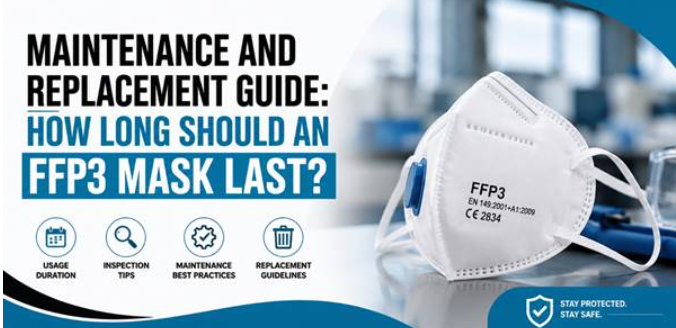
Your last line of defence against dust, fumes, vapours, and other dangerous particles is respiratory protective equipment, or RPE. That mask is protecting your lungs from major long-term harm, whether you’re on a demolition site or inside a spray booth. The risk subtly rises if it is worn out, not properly maintained, or used excessively.
It’s more important than ever to know how long your mask can actually protect you. Mask longevity is more than just a technical aspect. It’s what separates genuine protection from a delusion of security.
We’ll help you make better decisions with this guide on how to choose the best FFP3 mask, recognizing when it needs to be replaced, and taking care of it correctly so it performs its intended function.
Disposable vs Reusable FFP3 Masks: Lifespan Comparison
A recent UNEP and Life Cycle Initiative study compared the environmental impact of single-use and reusable FFP3 dust masks from the extraction of raw materials to disposal by reviewing several Life Cycle Assessments. A brief comparison based on those results is provided below:
| Feature | Disposable FFP3 | Reusable FFP3 |
| Typical Use Duration | Single shift (up to 8 hours) | Months to years (mask body) |
| Filter Lifespan | Built-in, single-use | Replaceable filters (hours to weeks, depending on exposure) |
| Maintenance Needed | None | Regular cleaning + filter replacement |
| Environmental Impact | More waste generated | Less waste due to reusable body |
| Cost Over Time | Higher with frequent use | More economical for regular users |
| Best For | Short-term or occasional tasks | Ongoing, high-frequency exposure |
Factors That Affect the Life of An FFP3 Mask
In harsh environments, even the best FFP3 mask filters lose some of their effectiveness. Their service life can be significantly shortened by a number of personal and environmental conditions.
- Level of Contaminants
The filter clogs more quickly in dirty air. Your particle filter may fill up in a matter of hours rather than days if you’re working with fine powders, smoke, or a lot of dust.
- The Temperature and Humidity
Dry activated carbon is used in gas and vapour filters to capture dangerous chemicals. The carbon becomes less effective, and the filter life is shortened when high humidity or heat fills those pores with moisture.
- Rate of User Work
The air and pollutants pass through the filter more quickly the harder you breathe. Physically taxing tasks shorten filter life and increase airflow. Always choose a reusable mask and filter type that is appropriate for the tasks at hand.
- Inadequate Storage
Degradation is accelerated when a mask is left in an unclean or moist environment between applications. Your reusable mask should always be kept out of direct sunlight and extremely hot or cold temperatures in a clean, dry case.
Telltale Signs Your FFP3 Face Mask Needs Replacement
In hazardous environments, such as asbestos removal, chemical industries, laboratories, or workplaces exposed to mineral dust and airborne infections, Category III PPE is crucial for safeguarding the respiratory system. The FFP3 standard establishes the threshold when health and safety cannot be compromised.
But how do you know if your FFP3 face mask is working properly or not?
- Issues in the face seal
In order to stop polluted air from seeping into the mask, the facial seal is essential. If you find splits, cracks, or other indications of brittleness, particularly along the edges where the reusable mask comes into contact with the face, it might be time for a replacement.
- Stretched head harness and straps
Straps are necessary for a snug fit and hold the mask in place. Look for fractures, fraying, or loss of elasticity. Even if the FFP3 dust mask is in good condition, the seal may be compromised by a poorly tensioned strap.
- Examine the housing and the valves.
In addition to facilitating airflow, valves also stop the accumulation of moisture and heat. Inhalation and exhalation valves should always be clear of rust, clean, and flexible. There should be no gaps, and the valve seat and housing should be in one piece.
- Breathing feels harder than usual
If you suddenly feel like you’re working extra just to breathe, that’s your mask struggling. The filter’s probably clogged up and not letting air pass properly anymore.
- You’re smelling stuff you shouldn’t
If random smells start sneaking through, your mask isn’t blocking things like it used to. That’s a red flag.
Tip: If you’re even slightly unsure, just replace or service your FFP3. Not worth gambling your lungs over it.
How To Choose A Long-Lasting FFP3 Mask?
In order for the comfort and protection of your FFP3 respirator to be balanced, you should consider the level of protection needed for the risk in the area, the workload, and the duration of use.
- Mask Shape: Cup, fold, or duckbill. Each offers a different balance of comfort, rigidity, and flexibility.
- The valve: For long shifts, the Moulded Disposable FFP3 mask is more comfortable to wear due to reduced heat and moisture. For closer contact or clinical use, unvalved masks like the Small FFP3 Masks Alpha S-3V are recommended as they filter the exhaled air.
- NR or R: “NR” stands for single-use in EN 149. “R” stands for “reusable” following durability testing. For safe reuse, always abide by the manufacturer’s instructions.
- Dimensions (S, M, L): Inward leakage is avoided with an appropriate seal. The proper fit enhances comfort and protection.
- Breathability (ΔP): Longer wear without strain is supported by lower breathing resistance.
- IIR type: Ideal for settings that need fluid resistance, such as technical or medical positions.
Pro tip: The safest option is ultimately determined by fit and context.
Maintenance Tips To Boost FFP3 Mask Lifespan
To maximize the effectiveness of your filter face mask, you must integrate filter care into your daily routine.
- To track the age of each filter, record the opening date.
- Daily check for any strong smells, signs of damage, or visible dirt.
- If you find it difficult to breathe, or you detect any smells, replace the filter immediately.
- Before replacing the filters, wash the reusable FFP3 dust masks if necessary with mild soap and water, and ensure they are completely dry.
- Follow the instructions provided by the manufacturer for each particular model, as even small design changes can affect the replacement time.
Final Thoughts
The performance of a filter face protective mask depends on the quality of the filter. For safety, it’s important to know how long filters last, both when in use and when stored. As filters reach their expiration, follow the manufacturer’s replacement guidelines.
Record the opening date on each filter and check any alert indicators. For optimal protection that lasts, choose the Valved and Non-valved, Fold Flat and Moulded Protective Masks from Protective Mask Direct. They provide the best comfort and effective breath-cleaning features for bearded users.
FAQs
How can I store my FFP3 mask correctly?
FFP3 masks should be stored in a cool and dry place. Avoid storage places where there is moisture and places where there are strong lights. Avoid storage spaces where there is a lot of dust. Avoid storage spaces where there is dust, moisture and strong lights.
Does cleaning a mask affect its performance?
Yes. Cleaning a mask can affect its performance. If the mask is cleaned using a strong cleaning agent, the mask may be damaged, and the seal may be compromised. Be sure to follow the manufacturer’s cleaning instructions.
Are FFP3 reusable masks worth it?
Yes, in most cases. Although reusable FFP3 masks with changeable filters may be more expensive to buy at the start, they are more cost effective in the long run, especially in places where it is required to have a respiratory protective device. In addition, they are less wasteful compared to single use FFP3 masks.
How long does an FFP3 mask usually last?
In most cases, this depends on the type of protective mask being used. If a single-use FFP3 mask has no breaks, tears, or heavy soiling, it can potentially last an entire shift, i.e. 8 hours. Reusable FFP3 masks last on the basis of how frequently the mask is used, how clean the mask is, condition of the straps and seals, and overall maintenance of the mask.
When is it time for a filter change?
Filters should be replaced when they become hard to breathe through, when there is an obvious buildup, or when there have been exposures to high concentrations of dust or hazardous particulates. Be mindful of usage guidelines from the manufacturer.