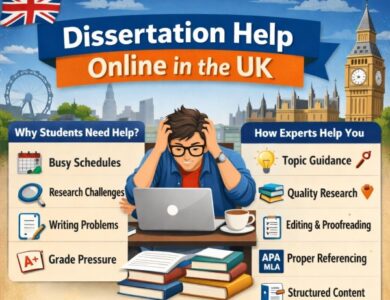
In the current British economic climate, the transition from higher education to a high-stakes professional environment has never been more demanding. As of 2026, the UK job market—influenced by shifting UCAS application trends toward vocational STEM degrees—is placing an unprecedented premium on technical proficiency.
Central to this shift is a growing recognition that academic support is no longer a luxury for the struggling, but a strategic tool for the ambitious. Whether through comprehensive degree modules or specialized technical certifications, students are increasingly turning to expert-led resources to secure a competitive edge in a saturated market.
Key Takeaways
- Strategic Grade Distinction: Recent HESA data indicates that 30% of UK graduates now achieve first-class honours, making the distinction between “pass” and “excellence” critical for elite recruitment.
- Specialised Skill Demand: Industries such as architecture, gaming, and sustainable engineering in the UK are projecting an 8% increase in demand for graduates with advanced spatial reasoning.
- The Human Advantage: Despite the rise of AI, UK universities have tightened “No-AI” policies, leading to a performance gap in favour of students receiving human-centric mentoring.
- Economic ROI: STEM graduates with high-tier mathematical grades earn an average of 15% more within their first five years in the UK workforce.
Data-Driven Insights: The UK Educational Shift
The landscape of UK education in 2026 reveals a significant trend: while overall pupil numbers in maintained schools have seen a slight decline, interest in high-level technical subjects is rising. According to recent results analysis, Mathematics remains the most popular A-level subject, reflecting its role as a gateway to the UK’s most lucrative industries.
However, popularity does not equate to ease. A significant portion of the Level 3 cohort—nearly 20%—reported that the leap from GCSE to University-level technical modules felt insurmountable without external support. To address these challenges, many students rely on specialized resources like online assignment help to bridge the gap between classroom theory and the rigorous standards required by the UK National Qualifications Framework (NQF).
Case Study: Bridging the Gap in UK Civil Engineering
Participant: James T., Year 2 BEng Student, University of Manchester.
Challenge: James faced a 45% failure rate in his “Advanced Structural Geometry” module. The curriculum required him to translate abstract Euclidean proofs into buildable spatial systems for urban infrastructure projects.
Intervention: James engaged with professional Geometry Assignment Help to supplement his lectures. Rather than using generic automated generators, he worked with a PhD-qualified expert who provided:
- Contextual Logic: Applying geometric theorems to real-world UK infrastructure, such as the modular designs used in modern London skyscrapers.
- Linguistic Accuracy: Ensuring all technical reports adhered to British English standards and specific university rubrics.
Outcome: * Grade Improvement: James’s marks rose from a 52% (2:2 range) to a 78% (First-Class).
- Professional Placement: Using his improved portfolio, James secured a summer internship at a leading UK-based design firm.
- Retention Success: Research indicates that proactive mentoring can improve student retention and GPAs by up to 35% compared to non-intervention group
Understanding the Intersection of Academic Support and Career Trajectory
To understand why these interventions are so effective, we must look at how academic mastery directly fuels professional velocity. The trajectory from foundational support to senior-level industry influence is often non-linear but highly correlated with early academic performance.
The Architecture of Mastery: Why Geometry Matters in 2026
In 2026, the UK’s architectural and design sectors are undergoing a transformation driven by Digital Fabrication and Parametric Modelling. Employers no longer view geometry as a “back-end” math subject; it is the “front-end” of design strategy. Proficiency in industry-standard tools like Revit and AutoCAD is now mandatory, and these platforms are built on complex geometric algorithms.
A student who masters coordinate geometry and modular design control is effectively learning the language of future construction. This skill set is essential for preventing fragmented layouts in urban planning and ensuring accuracy in volume calculations—factors that are critical for cost modelling and sustainability assessments in the British building sector.
FAQ Section
1. Is using academic support services legal in the UK?
Yes, it is legal to use such services as a learning aid. They act as a model for how to approach complex topics, helping students understand the high standards required for a first-class grade under the UK Quality Code for Higher Education.
2. How does geometry help in non-math careers?
Geometry is the foundation of logical reasoning. Beyond engineering, it is used in computer programming (game logic), medical imaging, and even financial trend analysis, where spatial data patterns are used to predict market shifts.
3. Why is “No-AI” content important for my degree?
UK universities prioritize original thought. Submitting AI-generated work carries high risks of academic misconduct. Human experts ensure the work is original, researched from credible journals, and properly cited.
4. Can mentoring really improve my employability?
Data suggests a 20% increase in graduation rates and a 15% increase in starting salaries for students who achieve high-tier grades. These grades act as a vital filter for the UK’s top graduate schemes.
Conclusion: Investing in the Future
As we look toward the next academic cycle, the message for UK students is clear: technical subjects are the building blocks of the modern economy. By leveraging expert assistance and dedicated subject-specific mentoring, students are not just completing a task—they are mastering a craft. In a world where AI is a tool, human expertise remains the true differentiator for those aiming for the pinnacle of British professional life.
Author Bio
Dr. Ricardo Hunt is a Senior Academic Strategist with a focus on STEM curriculum development. With over a decade of experience in the UK higher education sector, he specializes in helping students meet the rigorous standards of British universities to achieve their full professional potential.