Bro Split Workout Guide: Complete Training Method for Muscle Growth and Gym Success
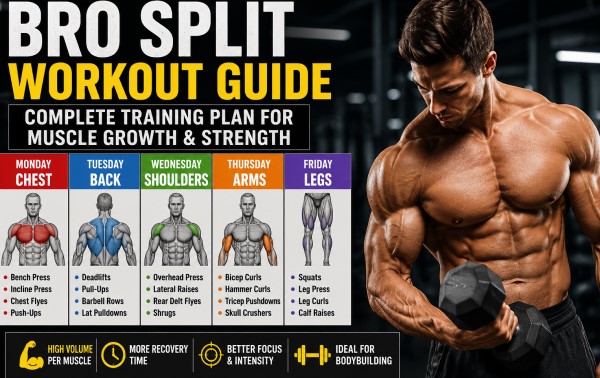
Table of Contents
ToggleIntroduction to Bro Split Training
The bro split is one of the most recognised and widely used workout routines in bodybuilding. It is a training method where each major muscle group is trained on a separate day, allowing lifters to focus intensely on one area of the body per session. This approach has been popular for decades, especially among bodybuilders aiming for muscle size, symmetry, and aesthetic development.
Unlike full-body or upper/lower training systems, the bro split focuses on high volume per muscle group with extended recovery time. This makes it particularly appealing for those who enjoy spending more time in the gym and targeting specific muscles with maximum effort.
In this article, we will explore everything about the bro split, including its structure, benefits, limitations, and whether it is suitable for beginners or advanced lifters.
What Is a Bro Split?
A bro split is a workout routine where you train one major muscle group per day across a weekly schedule. The idea is to dedicate an entire workout session to a single muscle group, such as chest, back, shoulders, arms, or legs.
Typical Weekly Bro Split Structure
A standard bro split gym routine looks like this:
- Monday: Chest
- Tuesday: Back
- Wednesday: Shoulders
- Thursday: Arms (Biceps and Triceps)
- Friday: Legs
- Saturday: Optional abs or cardio
- Sunday: Rest
This structure allows each muscle group to recover for nearly a full week before being trained again.
How the Bro Split Works in Gym Training
The bro split is based on the principle of muscle isolation and volume training. Instead of training multiple muscle groups in one session, you concentrate all your energy on one area. This enables:
- Higher number of sets per muscle
- Better focus on form and contraction
- Increased mind-muscle connection
- Greater pump and muscle fatigue
Example of Chest Day in Bro Split
A typical chest workout may include:
- Barbell Bench Press – 4 sets
- Incline Dumbbell Press – 4 sets
- Cable Flyes – 3 sets
- Push-ups – 3 sets to failure
This level of volume is repeated for each muscle group on different days.
Benefits of the Bro Split
The bro split remains popular for several strong reasons. While modern fitness science often recommends higher frequency training, the bro split still has unique advantages.
High Training Volume Per Muscle
One of the biggest advantages is the ability to perform a large number of sets for each muscle group. This high volume can contribute to muscle hypertrophy when performed correctly.
Better Focus and Concentration
Since only one muscle group is trained per session, lifters can fully concentrate on that area without distraction. This improves technique and mind-muscle connection.
Improved Recovery Time
Each muscle gets approximately 5–7 days of recovery. This is beneficial for advanced lifters who train with heavy weights and high intensity.
Ideal for Bodybuilders
The bro split is widely used in bodybuilding because it supports muscle shaping, symmetry, and aesthetic improvement rather than just strength.
Simple and Easy to Follow
The structure is straightforward. Beginners can easily remember their training schedule without confusion.
Limitations of the Bro Split
Despite its popularity, the bro split is not perfect. It has several limitations that should be considered before adopting it as a long-term training plan.
Low Training Frequency
Each muscle is typically trained only once per week. Research suggests that training muscles two times per week may lead to faster growth for many natural lifters.
Not Ideal for Beginners
Beginners often benefit more from full-body or upper/lower splits because they require more frequent practice of movement patterns.
Missed Workouts Affect Progress
If you miss a single day, an entire muscle group may go untrained for two weeks, which can slow progress.
Longer Gym Sessions
Bro split workouts often last 60–90 minutes or more, which may not suit people with busy schedules.
Can Anyone Do a Bro Split?
The bro split can technically be followed by anyone, but its effectiveness depends on experience level, goals, and lifestyle.
Best Suited For:
- Intermediate and advanced gym-goers
- Bodybuilders focusing on aesthetics
- People training 5–6 days per week
- Individuals who enjoy long workout sessions
Not Ideal For:
- Complete beginners
- People training fewer than 4 days a week
- Those focused primarily on strength performance
- Individuals needing fast, efficient workouts
Beginners often progress faster with full-body or push/pull/legs routines because of increased muscle stimulation frequency.
Bro Split vs PPL (Push Pull Legs)
The most common comparison in modern fitness is between the bro split and the Push Pull Legs (PPL) system.
Bro Split Overview
- One muscle group per day
- High volume per session
- Lower frequency per muscle
- More bodybuilding-focused
Push Pull Legs Overview
- Push: Chest, shoulders, triceps
- Pull: Back, biceps
- Legs: Lower body
- Each muscle trained twice weekly
Key Differences
Muscle Frequency
Bro split trains muscles once per week, while PPL trains them twice per week. Higher frequency often leads to faster muscle growth.
Workout Efficiency
PPL workouts are generally shorter and more balanced, while bro splits can be longer and more intense per session.
Recovery
Bro splits offer longer recovery per muscle, whereas PPL balances recovery across the week.
Best Use Case
- Bro split: bodybuilding aesthetics and isolation focus
- PPL: strength, hypertrophy, and overall fitness
Example Bro Split Gym Program
Here is a practical weekly bro split plan:
Chest Day
- Bench Press – 4 sets
- Incline Dumbbell Press – 3 sets
- Cable Flyes – 3 sets
- Dips – 3 sets
Back Day
- Deadlifts – 4 sets
- Lat Pulldowns – 3 sets
- Barbell Rows – 4 sets
- Seated Cable Rows – 3 sets
Shoulder Day
- Overhead Press – 4 sets
- Lateral Raises – 4 sets
- Rear Delt Flyes – 3 sets
- Shrugs – 3 sets
Arm Day
- Bicep Curls – 4 sets
- Hammer Curls – 3 sets
- Tricep Pushdowns – 4 sets
- Skull Crushers – 3 sets
Leg Day
- Squats – 4 sets
- Lunges – 3 sets
- Leg Press – 4 sets
- Calf Raises – 4 sets
Is the Bro Split Effective for Muscle Growth?
Yes, the bro split can build significant muscle when applied correctly. Its effectiveness depends on:
- Progressive overload
- Proper nutrition
- Sufficient protein intake
- Quality sleep and recovery
- Training intensity
However, modern research suggests that muscle growth is often maximised when each muscle group is trained more frequently. This is why many lifters eventually transition from bro splits to PPL or upper/lower routines.
Final Thoughts on Bro Split Training
The bro split remains a classic and respected training method in the fitness world. It is especially effective for individuals who enjoy focused workouts, high-volume training, and bodybuilding-style routines.
While it may not be the most efficient system for beginners or strength-focused athletes, it still has a strong place in gym culture. If your goal is aesthetic development and you enjoy spending time isolating muscle groups, the bro split can be an excellent choice.
Ultimately, the best workout plan is the one you can follow consistently. Whether you choose a bro split or another training system, consistency, intensity, and discipline will always determine your results.