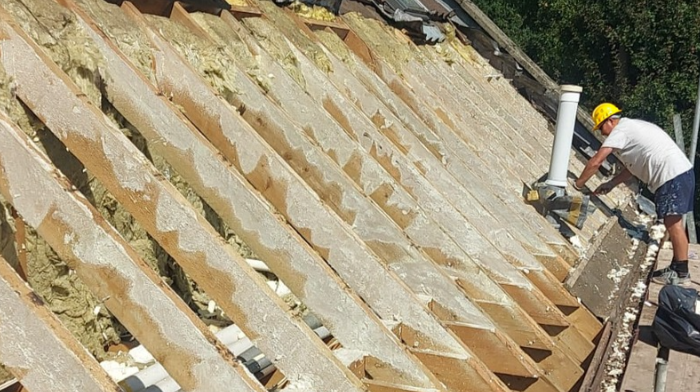
Spray foam is sometimes applied directly against roofing felt or membrane, which creates a different removal challenge from foam sitting only between exposed rafters. Homeowners often ask whether the material underneath can be saved, whether the roof must be stripped externally and what happens if the foam will not separate cleanly. The answer depends heavily on the roof build-up and the condition of the layer beneath the foam.
Why roof felt and membrane complicate removal
Traditional bitumen felt, modern breathable membranes and other roof underlays perform different functions and do not all react the same way when bonded to cured foam. Older felt can already be brittle. A membrane may be sound but vulnerable to tearing if foam is pulled away too aggressively.
That is why professional spray foam removal should start by identifying what lies behind the insulation, not simply by choosing the fastest way to detach it.
The roof build-up matters more than the foam alone
UK Government-commissioned modelling on spray foam insulation in timber sloped roofs looked at different combinations of foam, underlay and vapour-control arrangements. The findings reinforce an important practical point: moisture and timber risk are configuration-dependent. Two roofs with apparently similar foam can behave very differently because the layers behind it are different.
Can the felt be kept?
Sometimes. If the underlay is serviceable and the foam can be separated without destroying it, internal removal may leave much of the existing roof build-up in place. In other properties, the felt may already be degraded, torn or so heavily bonded that sections need local repair or replacement.
The key is not to promise preservation before the surface can be assessed. A contractor can often estimate likely difficulty from a survey, but the final condition only becomes clear as removal progresses.
What happens during a careful removal
- The bulk foam is cut away to reduce pressure on the underlay.
- The material is worked back from rafters and junctions in smaller sections.
- The operator avoids pulling large bonded sheets that could tear the felt or membrane.
- Once exposed, the underlay is checked for holes, brittleness, detachment or previous leak damage.
- Any necessary local roofing work is separated from the foam-removal scope so the homeowner can see what actually needs repairing.
Does damaged felt mean a complete re-roof?
Not automatically. The answer depends on how widespread the damage is, the age of the roof covering and whether local repairs can be made effectively. A roof already near the end of its service life may justify more extensive work, while isolated defects may not. Foam should not be used as a shortcut for diagnosing the entire roof.
Why documentation is useful
Before-and-after photographs can show whether the foam was bonded to felt, what condition the underlay was in when exposed and what repairs were made. That record is useful for future roof maintenance and can be particularly helpful if a surveyor later asks why sections of membrane look newer than others.
Homeowners can also review likely spray foam removal costs before commissioning work, because membrane repairs and difficult detailing are two of the factors that can move a job above a simple headline estimate.
Inspect first, then decide how much roof work is really needed
Foam bonded to roof felt is a complication, not an automatic sentence for the whole roof. The best outcome comes from controlled internal removal, assessment of the exposed underlay and targeted repair based on what is actually found.