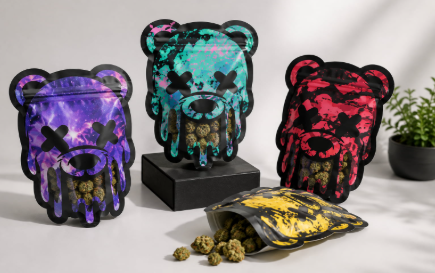
The strange shapes are what draw attention first, but only work as long as the bag behind the shape still fulfills its purpose. A brand may invest weeks to refine a silhouette and still have a package that allows moisture to enter or collapses on the way. The shape can be worked out before any shape is finalized by knowing what the product requires structurally as a flashy outline becomes nothing when the seal beneath cannot sustain it.
Let the Product Decide the Shape, Not the Other Way Around
One falls in love with a shape without having to find out whether the shape is suitable for the product being placed inside it. The weight, texture and the response to air and light must be mentioned first as a heavier or oilier product requires a firmer structure as compared to a light and dry one. This is what makes the difference between die cut mylar bags that perform and those that merely look good on a mockup.
The Barrier Layer Customers Never Notice Until It Fails
Most of the actual work is being done by the film below the print. Its task is to retain oxygen, moisture and light sufficiently long to enable the product to remain fresh throughout its shelf life and that requires a really fine layer thickness and lamination quality.
Grand View Research predicts that in the product type of flexible packaging alone, pouches comprise about 39% of the market in 2025, indicating the extent to which brands have come to rely on pouch-like packaging precisely for this form of protection. The difference between custom die cut mylar bags, which will last months and those that will not make it to the pantry of a customer is a well built barrier layer.
Designing a Shape of Die Cut Mylar Bags That Still Stands Up on a Shelf
Die-cutting opens the door to new imaginative silhouettes yet an odd form must act predictably when filled and placed next to dozens of competing products. The width of the base, distribution of weight and the way the bag will sit when stacked all influence the ability of the bag to retain its shape or to slump. A shape which looks sharp in a drawing but spills on a retail shelf is not doing its job, however distinctive the outline may be.
Getting the Closure Right the First Time
The decision to close should not be an add-on or something added once the shape is fixed. The resealable zipper should be used with products that customers dip and re-dip, a heat seal is used with single-use or tamper-evident products, and a tin-tie or fold-top is used with the products that require a stronger reusable closure. Making the wrong one tends to manifest itself later on as customers complaining, rather than an issue of design that anyone discovers early.
Surviving the Trip From Factory to Shelf
Even a pouch that sits well on a shelf can break somewhere in between the production line and the store. Stacking compression, temperature variations and repeated handling in distribution place actual stress on seams and irregular die-cut shapes may be more susceptible to stress points than a standard rectangular pouch unless the film and seal are designed to handle it. Brands that pass through multiple distribution points normally require a heavier film and reinforced seals to take into consideration that additional handling.
Why a Trial Run Saves Money Later
Any omission of a sample order to meet a launch date is virtually always more expensive in the future. Filling, sealing and simple transportation testing of an actual product are likely to reveal issues not shown in a spec sheet, such as a seal that is marginal, a shape that does not fill out or a misplaced zipper during manufacture. It is much less expensive to intercept a piece before it ships than to remanufacture a part or scrap inventory.
American Manufacturers Pushing Die-Cut Packaging Forward
Some US-based packaging firms have established a niche in assisting brands to achieve unique, high-quality pouches free of enterprise-level requirements of order quantities. A glance at some of them side by side illustrates the difference in ways in which custom is performed according to the production behind it.
Kwick Packaging
Kwick Packaging uses a structural approach first, to visit through barrier requirements, film thickness and closure type to complete the die-cut shape and print the sequence that was already discussed in this paper. The combination has proven to be hard to find by brands seeking die cut mylar Packaging bags that can be produced in-house, with flexible order sizes and hands-on support through sampling. It is the type of facility that can be reasonably considered by brands like those that resemble well-known brands in the packaging arena such as specialty product brands like Dragon Chewer their own custom runs.
Two of our recent customers have reported their experience as follows:
“They did such a great job communicating and were very efficient. I will continue using them for sure.” Jennifer Ragland
“I am running a mobile business and ordered packaging for my needs at Kwick Packaging; their design team was so cooperative and I received my order as per my expectations.” Ijaz Faiz Ijaz
BowePack
BowePack has developed a fan club of quick production cycles with smaller custom orders that fits brands with a narrow launch target. They are inclined to a more conventional form of digital printing, which is effective when production is short-run but has less capacity to produce very specialized die-cut silhouettes.
BrandMyDispo
BrandMyDispo places a lot of emphasis on brand-oriented packaging based on retail and dispensary based products and finishes and print quality. That strength is an asset to shelf presence, but the brands with higher technical barrier or thickness requirements might desire to establish film specifications before ordering at volume.
What to Know Before Ordering Wholesale
Custom mylar bags wholesale have actual cost benefits, but only when the quantity ordered is equal to the amount that the brand can move before the product grows old. The total market of flexible packaging was estimated at approximately 293.9 billion pounds in 2025 and the bag-and-pouches segment took approximately 38 percent of all types of packaging sold in the same year an indicator of how fierce the competition is among packaging suppliers, as far as the wholesale market is concerned. It is worth inquiring of a supplier directly regarding minimum order quantities, price breaks at various levels and the availability of small trial quantities before making a commitment to a complete wholesale order.
Mistakes That Undercut an Otherwise Good Design
Some of these problems are recurrent: selecting a die-cut shape without making sure the barrier film can handle it, skipping orders of samples to save a week or two, not accounting for the stress of shipping an irregular shape, and selecting a closure that is not consistent with how the customers actually use the product. All of these errors are not disastrous in their own right, but when compounded, they add up to typically why a custom package performs worse than claimed in the pitch deck.
Pulling It All Together
A distinctive shape is only half the equation. The other half is barrier performance, shelf stability, the right closure and a manufacturing partner that tests before scaling to volume. Brands that consider the shape and the structure as a single decision not design first, engineering later are likely to have packaging that actually does what it appears to do.
FAQs
- Do die-cut mylar bags protect as well as stand-up pouches do?
Yes, provided that the quality of the barrier film and seal is the same as the one that a regular pouch would have. The shape does not lower any protection; it is up to the lamination and thickness of the film whether the product within was designed properly.
- What is the average minimum order of custom die cut mylar bags?
It differs according to manufacturers. Other custom mylar bag suppliers sell them by wholesale with no or low minimums on standard shapes and very specialized silhouettes can have a higher minimum to offset the cost of die-cutting tools.
- What is the duration of time to have an individual die-cut shape made?
Timelines are based on the availability of a die with the shape required. Ready-made forms may usually be delivered within two weeks, whereas a completely bespoke form would demand an initial investment of time to make the die and a sample acceptance phase before everything could be manufactured.